Linear Things: Systems of Linear Equations
What is a System of Linear Equations?
A system of linear equations combines two or more linear equations at the same time. In most cases, this is two linear equations, but can be extended to more than two. For example, the following is a system of linear equations:
$$\begin{array}{c} 3x-5y=-2 \\ y=-6x+7 \end{array}$$
Each equation can be written in any form already discussed: standard, slope-intercept, point-slope or \(x=\) form. In the system above, the first equation is in standard from and the second equation is in slope-intercept form.
A solution to the system, is a value for \(x\) and a value for \(y\) that makes BOTH equations true. In the above system, \(x=1\) and \(y=1\) form a solution to the system since:
$$\begin{array}{cccccc} 3(1)-5(1)=-2 & \implies & 3-5=-2 & \implies & -2=-2 & \text{True} \\ 1=-6(1)+7 & \implies & 1=-6+7 & \implies & 1=1 & \text{True} \end{array}$$
Solving Algebraically - Substitution Method
The substitution method is best used when one of the equations is already for a variable. In other words, when one equation is in \(x=\) or \(y=\) form.
Example
Solve the system to see where the solution \(x=1\) and \(y=1\) came from using substitution: \( \begin{array}{c} 3x-5y=-2 \\ y=-6x+7 \end{array} \)
| Step 1: Replace \(y\) in first equation with \(-6x+7\) from second equation: |
\(3x-5\left(-6x+7\right)=-2\) |
| Step 2: Algebra to solve for \(x\): |
\(3x+30x-35=-2\) |
|
\(33x=-2+35\) |
|
\(33x=33\implies x=1\;\color{green}{\checkmark}\) |
| Step 3: Plug \(x=1\) back in and solve for \(y\) |
\(y=-6(1)+7\) |
|
\(y=-6+7\implies y=1\;\color{green}{\checkmark}\) |
NOTE: Some algebra may be needed to rewrite an equation in \(x=\) or \(y=\) form.
Solving Algebraically - Addition Method
The addition method is best used when both equations are in standard form. The basic idea is to have opposite coefficients and add together to get 0. For example, if we had \(9x\) in one equation and \(-9x\) in the other equation (on the same side of \(=\)), then adding together results in \(0x\). The key is to multiply each equation by the correct multiplier in order to have opposite coefficients.
Example
Solve the system: \( \begin{array}{c} 5x+8y=-11 \\ -4x+3y=12 \end{array} \)
| Step 1: Determine correct multipliers to cancel \(x\) |
Multiply first equation by \(4\) and second by \(5\) |
|
\(4\left(5x+8y=-11\right)\) |
\(\implies20x+32y=-44\) |
|
\(5\left(-4x+3y=12\right)\) |
\(\implies-20x+15y=60\) |
| Step 2: Add resulting equations together: |
\(\begin{array}{c} 20x+32y=-44 \\ \underline{+ \; -20x+15y=60} \\ 0x+47y=16 \end{array}\) |
\(\implies y=\frac{16}{47}\) |
| Step 3: Repeat to cancel \(y\) |
Multiply first equation by \(-3\) and second by \(8\) |
|
\(-3\left(5x+8y=-11\right)\) |
\(\implies-15x-24y=33\) |
|
\(8\left(-4x+3y=12\right)\) |
\(\implies-32x+24y=96\) |
| Add resulting equations together: |
\(\begin{array}{c} -15x-24y=33 \\ \underline{+ \; -32x+24y=96} \\ -47x+0y=129 \end{array}\) |
\(\implies x=-\frac{129}{47}\) |
| Final Answer: |
\(\implies\left(-\large{\frac{129}{47},\frac{16}{47}}\right)\;\color{green}{\checkmark}\) |
NOTE: An alternative to doing the addition method a second time is to plug in \(y=\frac{16}{47}\) into any equation and solve for \(x\).
Solving by Graphing
In the previous topic, graphing lines from all different forms was discussed. When looking at a system of linear equations, we can see how the graphs of the lines interact. There can be three possibilities:
- Two lines can intersect in exactly one point: \( \left( x_i,y_i\right)\).
- Two lines may not intersect at all, this means the lines are parallel: recall, that means have the exact same slope.
- Two lines may intersect at every point: meaning the equations have the exact same slope and exact same \(y\)-intersect.
Example
The table below shows graphically systems of linear equations described above.
| Exactly ONE solution |
No solutions |
Infinitely many solutions |
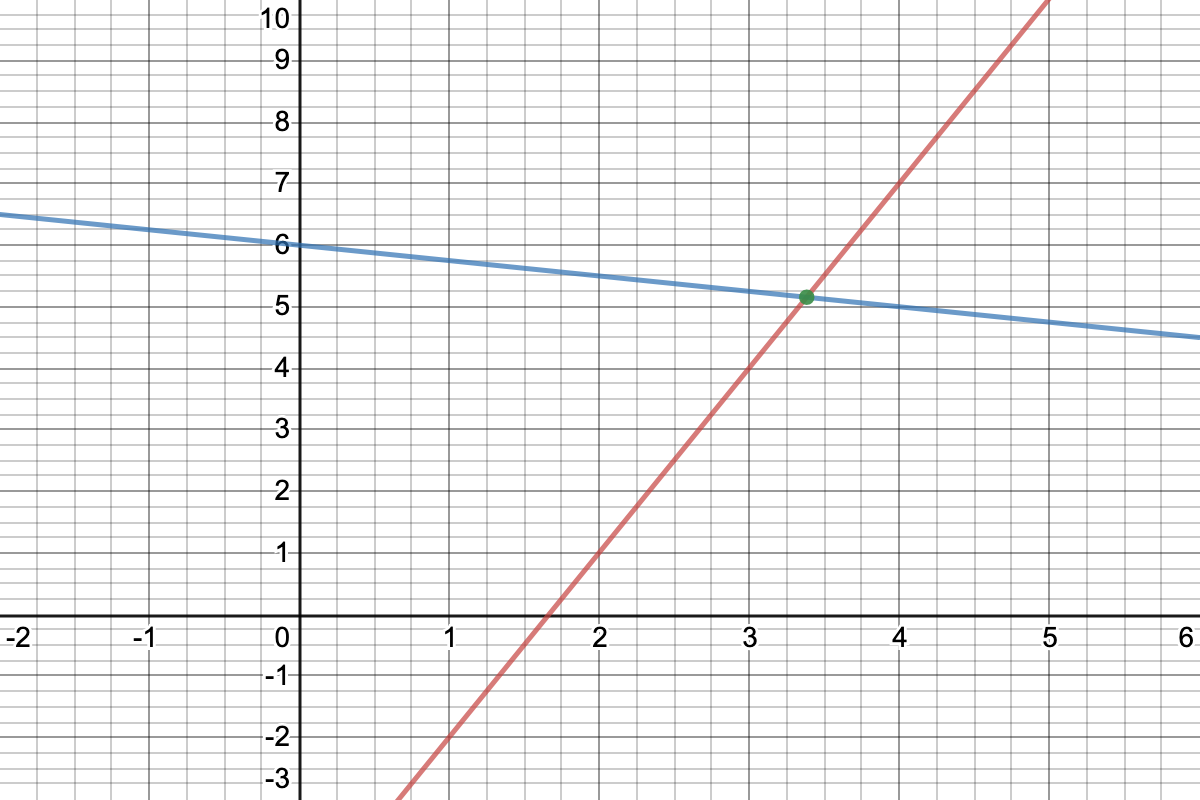 |
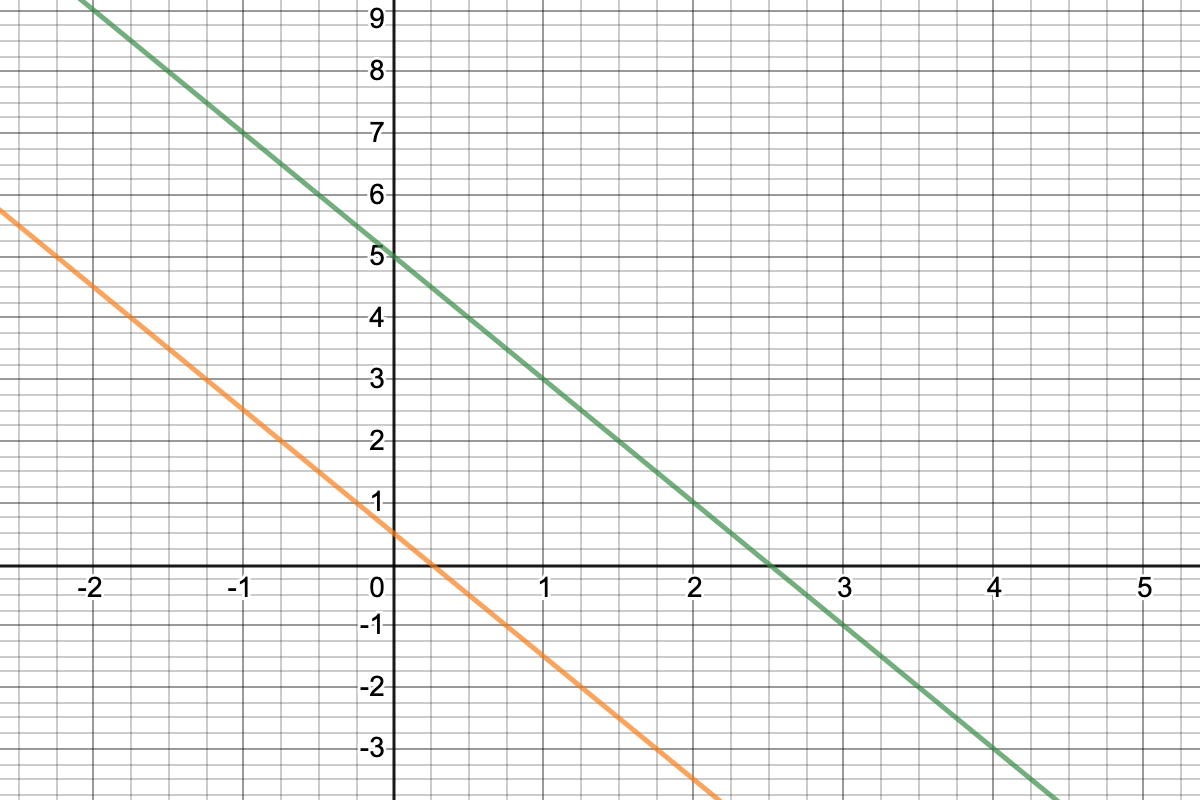 |
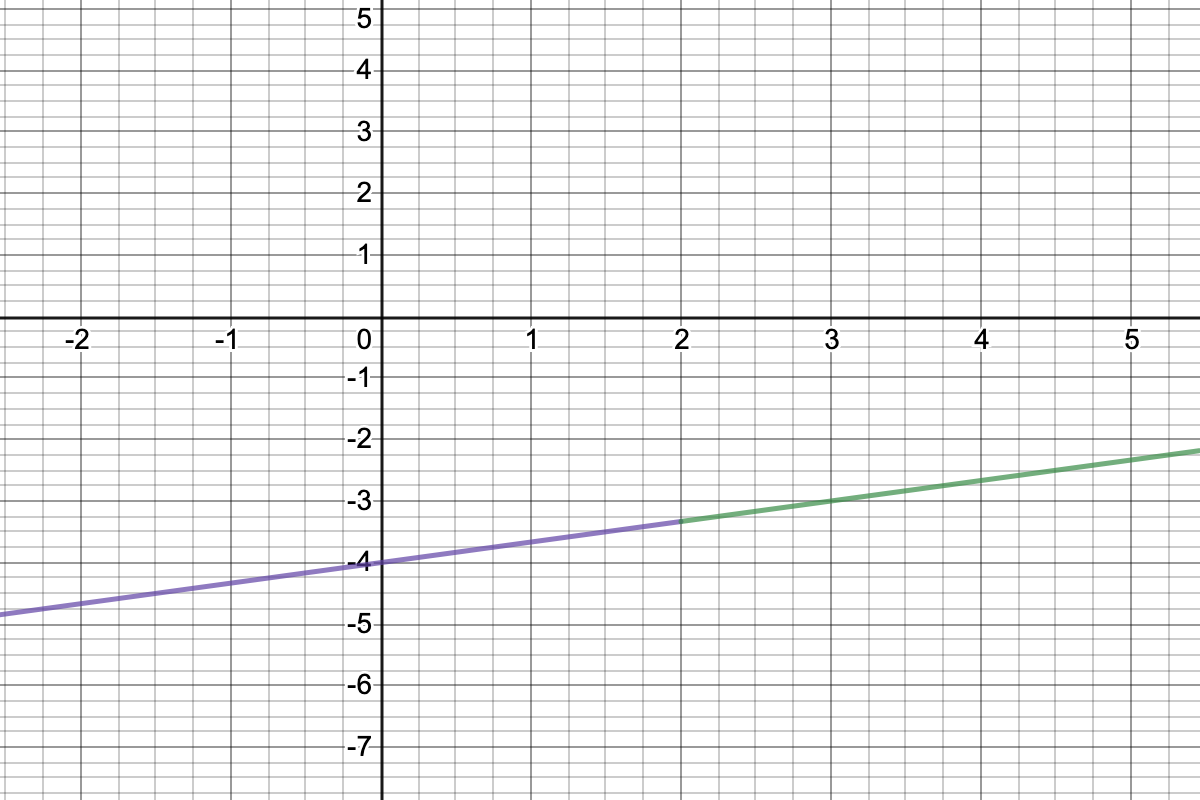 |
Final Thoughts
The algebra should also show what the graphing shows. When working on the substitution or the addition methods, the algebra will give exactly one solution, no solution (parallel lines) or infinitely many solutions (exact same line). Getting a solution should be easy. No solution occurs when all the variables cancel, and you get something false, like \(-3=7\). Infinitely many solutions occurs when all the variables cancel, and you get something true, like \(12=12\).