A linear inequality in one variable is any expression using one of the four inequality symbols:
\(<\)
means is less than
\(4 < 7\) would be true since \(4\) is less than \(7\)
\(\leq\)
means is less than or equal to
\(2\leq 5\) and \(3\leq 3\) would both be true
\(>\)
means is greater than
\(10 > 6\) would be true since \(10\) is greater than \(6\)
\(\geq\)
means is greater than or equal to
\( 11 \geq 8 \) and \( 9 \geq 9 \) would both be true
Solving Linear Inequalities:
To solve a linear inequality, proceed as if you are solving a regular equation. There is only one key thing to remember: If you multiply or divide BOTH sides of the inequality by a negative number, then the symbol changes direction.
Example
Solve for \( k \): \( 2k-5 < 1+k \)
Step 1
$$2k-5 \color{blue}{-k} < 1+k \color{blue}{-k}$$
Subtract \( k \) on both sides
$$k-5 < 1$$
Combine like terms
Step 2
$$k-5 \color{blue}{+5} < 1 \color{blue}{+5}$$
Add \(5\) on both sides
$$k < 6$$
Combine like terms
Notice that only addition and subtraction were needed to solve for \( k \). The next example shows what happens when multiplication or division by a negative number occurs.
Both examples above provide solutions in which many numbers work, in fact, an infinite amount of numbers. So we need a method to describe all of these solutions. This is where interval notation comes into play. Interval notation describes pieces of the real number line. The entire number line is described by \( \left( -\infty,\infty \right) \). The table below summarizes the rest of the intervals.
NOTE:
The table above also shows Set-Builder Notation. Interval Notation is my preferred interval language.
Revisit Examples with Interval Notation
Going back to the examples above, we did the algebra to solve them, now let's show the answers expressed in interval notation:
Algebra Solution
Interval Notation
Graph
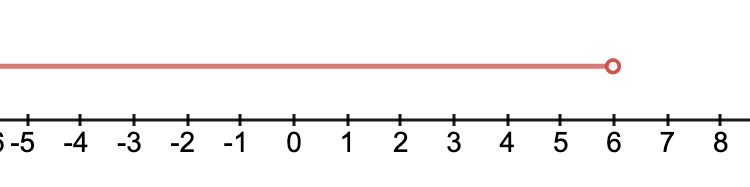
$$k < 6$$
$$\left( -\infty,6 \right)$$
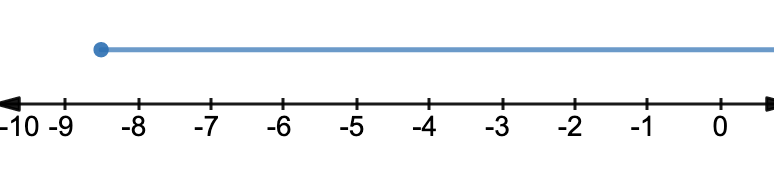
$$x \geq -\frac{17}{2}$$
$$\left[ -\frac{17}{2},\infty \right)$$
Open Circles, Closed Circles?
Notice in the graphs above, the first has an open circle at \( k=6 \) and the second has a closed circle at \( x=-\frac{17}{2} \). What is causing this difference? The issue comes from the inequality symbol, and you should always ask the question: Is the inequality allowing equal to or not? In the first graph, the inequality is less than only, meaning \( k=6 \) is NOT allowed as a solution. The graph indicates this by an open circle. In the second graph, the inequality is greater than or equal to, ALLOWING \( x=-\frac{17}{2} \) as a solution. The graph indicates this by a closed circle.