Linear Things: Graphing Lines
In this section we will discuss the most efficient manner to graph lines from each form. The main idea is to be able to sketch and understand the graph by hand, then check the result with Desmos, a free online graphing utility.
Graphing from Standard Form
In standard form, we find two specific points from the equation and then graph the line that passes through those two points. The \(x\)-intercept is where the line intersects the \(x\)-axis and is defined by the point \(\left(\#,0\right)\). Similarly, the \(y\)-intecept is where the line intersects the \(y\)-axis and is defined by the point \(\left(0,\#\right)\). Using the equation, we can find these points to graph the line.
Example
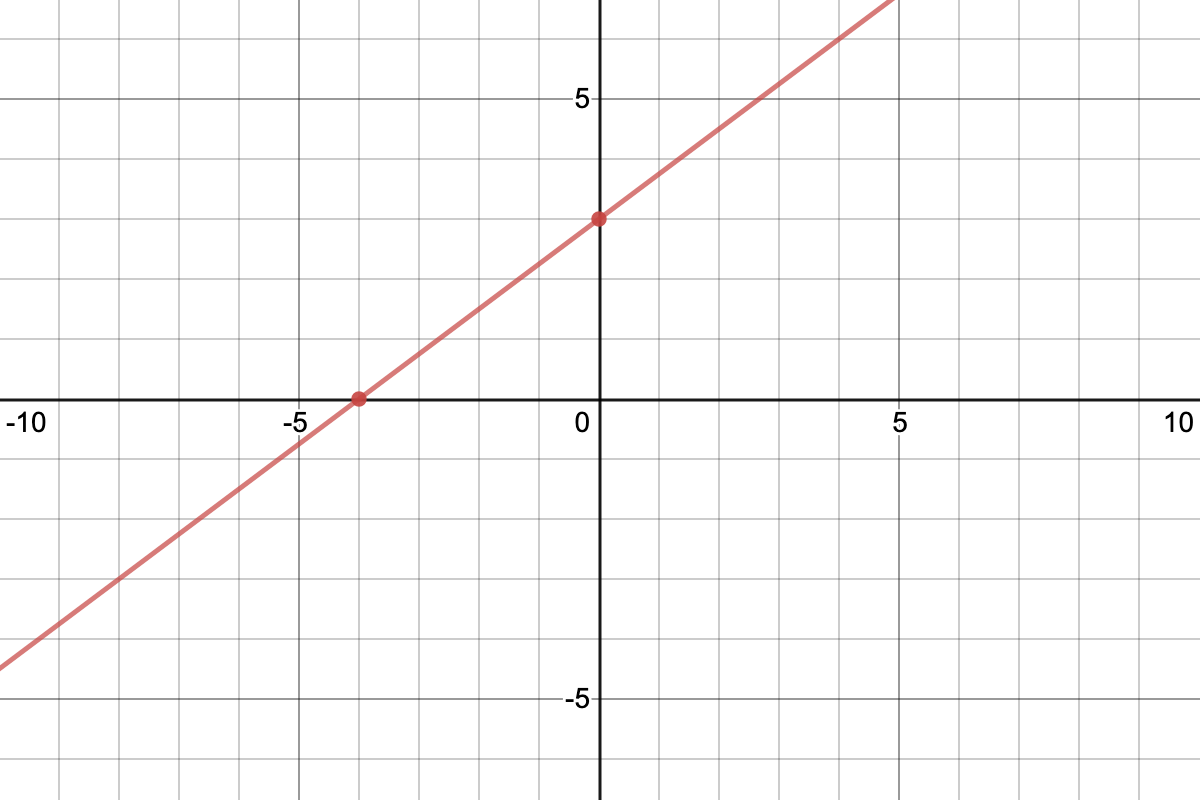
Sketch a graph of the line given by \( 6x-8y=-24 \).
| \(x\)-intercept means \(y=0\): |
\(6x-8(0)=-24\implies 6x=-24\implies x=-4\) |
Get point \((-4,0)\) |
| \(y\)-intercept means \(x=0\): |
\(6(0)-8y=-24\implies -8y=-24\implies y=3\) |
Get point \((0,3)\) |
Graphing from Slope-Intercept Form
Two great things come out of the slope-intercept form: #1 the slope of the line and #2 the \(y\)-intercept given by \((0,b)\). Always start at the \(y\)-intecept and then use the slope to find a second point. Since the slope is a ratio, or fraction, the numerator gives the vertical movement (up for a positive slope and down for a negative slope). The denominator gives the movement to the right (always move to the right to avoid confusion).
Example
Sketch a graph of the line given by \(y=-\frac{5}{4}x+3\).
| From the equation: \(m=-\frac{5}{4}\) and the \(y\)-intercept is \((0,3)\) |
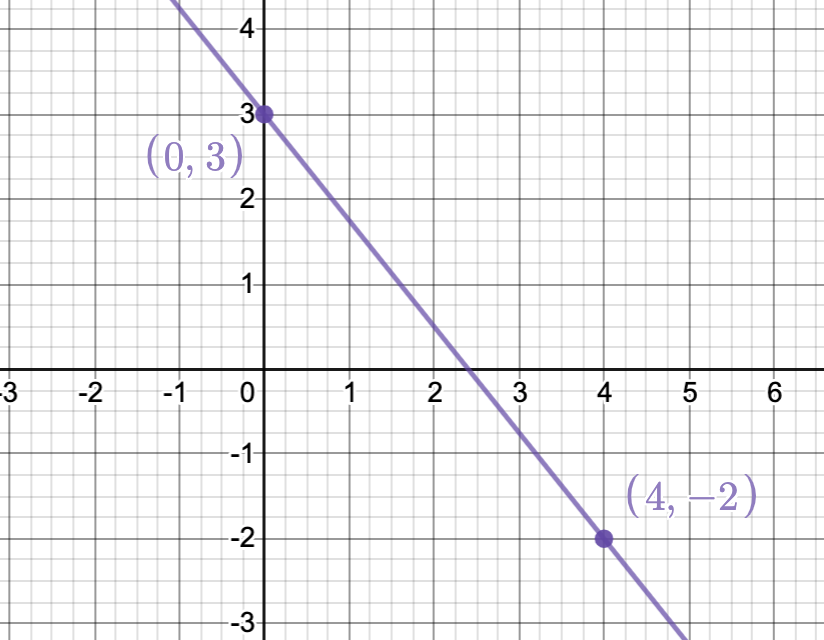 |
| Start at \((0,3)\) and use the slope: down \(5\) (since \(m\) is negative) and right \(4\) |
| This gives a new point \((4,-2)\), sketch line passing through these points. |
Graphing from Point-Slope Form
The technique for graphing from point-slope form is very similar to graphing from slope-intercept form. The major difference is what point you start from. Recall from \(y-y_{i}=m\left( x-x_{i}\right)\) the point is given by \(\left(x_{i},y_{i}\right)\). This is the point to start from instead of the \(y\)-intersept like in slope-intercept form.
Example
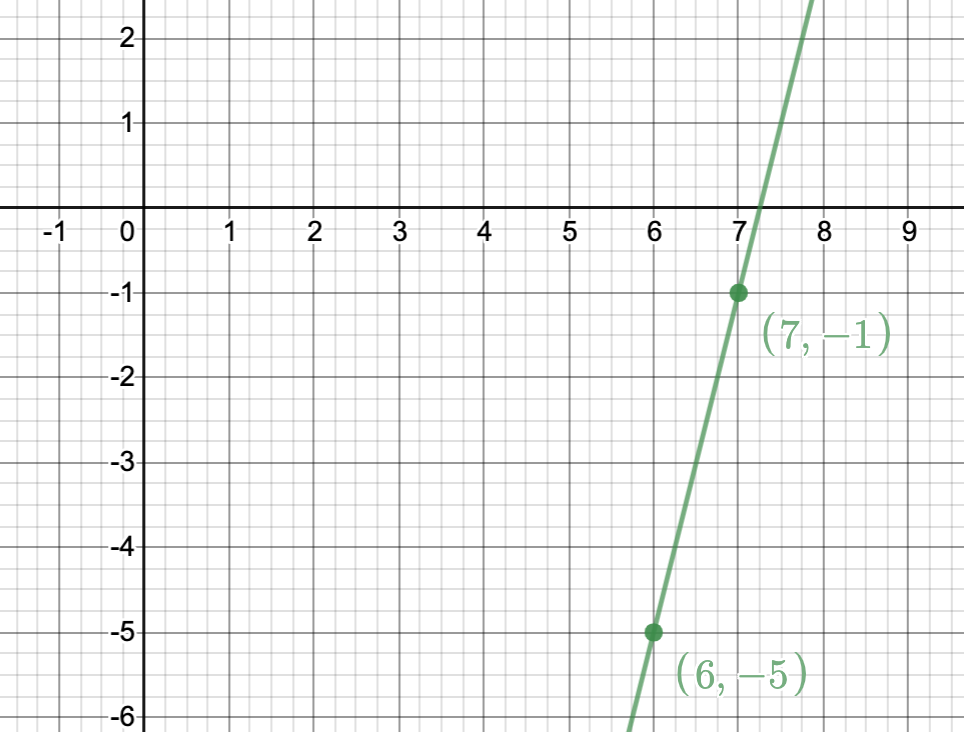
Sketch a graph of the line given by \(y+5=4(x-6)\).
From the equation, the point is \((6,-5)\), remember to
take the opposite sign from what is used in the equation.
The slope is \(m=4\), which is also a fraction \(m=\large{\frac{4}{1}}\).
Start at \((6,-5)\) then use the slope: up \(4\) (since \(m\) is positive)
and right 1. This gives a second point at \((7,-1)\)
Now draw the line that passes through the two points.