Factoring: Applications of Factoring
The main focus is how factoring can be used to solve word problems. Using our work from the applications in the Linear Things section, the most difficult part is creating the equation that needs to have a factorable trinomial. Once that equation is made, we can factor and use the ZPP just like in the last topic.
Example
Sam is planning to build a rectangular deck along the back of his house. He wants the area of the deck to be \(60 m^2\) and the width to be \(1m\) less than half the length of the deck. What length and width should he use?
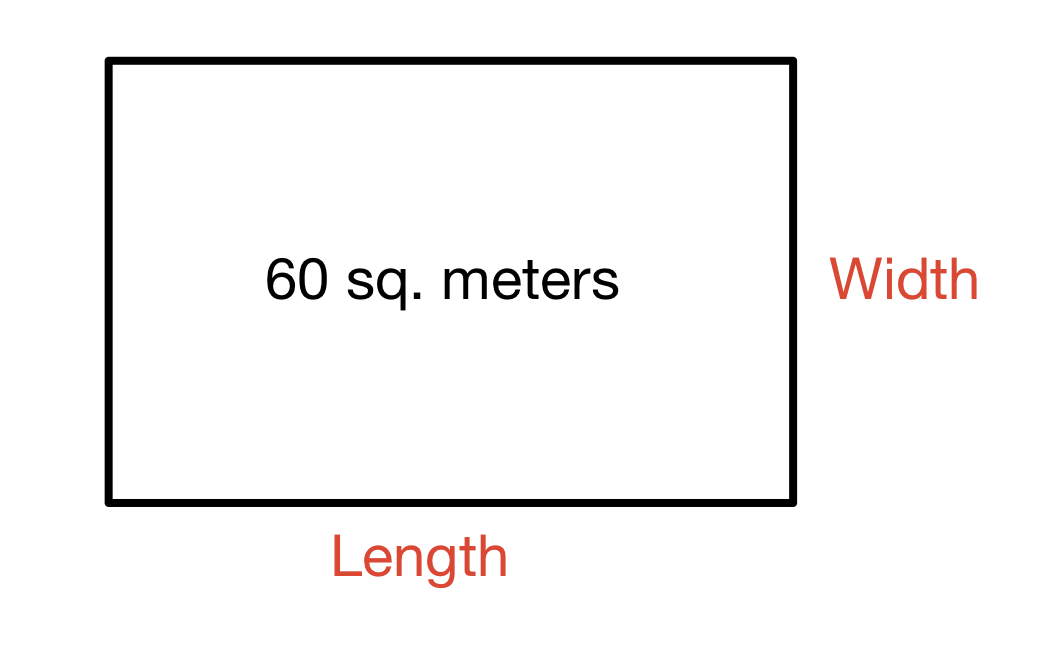 |
Let the length be \(x\). That gives the width as \(\frac{1}{2}x-1\). |
| The deck's area is \(60m^2\) so the equation: \(x\left(\frac{1}{2}x-1\right)=60\) | |
| Multiply by 2 to clear the fraction: \(x^2-2x=120\) | |
| \(\implies x^2-2x-120=0\) | |
| \(\implies \left(x-12\right)\left(x+10\right)=0\) | |
| \(x-12=0 \text{ and } x+10=0\) | |
| \(\implies x=12 \text{ and } x=-10\) | |
| The only solution is \(x=12\) so the deck has a length of \(12\) meters and a width of \(5\) meters |