Calculus
Section 3.3 - Special Case \(f(x)=e^x\)
Consider the exponential function defined by \(f(x)=e^x\). Using the limit definition, we are going to show that this function has a very special derivative.
To begin, use the limit definition: $$f'(x)=\lim_{h\rightarrow0}\left(\frac{f(x+h)-f(x)}{h}\right)\implies\lim_{h\rightarrow0}\left(\frac{e^{x+h}-e^x}{h}\right)$$ By rules of exponents, we can separate \(e^{x+h}\) into \(e^x\cdot e^h\): $$\implies f'(x)=\lim_{h\rightarrow0}\left(\frac{e^x\cdot e^h-e^x}{h}\right)$$ By algebra, we can factor out \(e^x\), and since the limit is in terms of \(h\) not \(x\), we can pull \(e^x\) outside of the limit: $$\implies f'(x)=e^x\cdot\lim_{h\rightarrow0}\left(\frac{e^h-1}{h}\right)$$
The question then becomes, what is the value of that limit? Later we will learn a very quick method to evaluate this limit, but for now, let's just use numerical evidence:
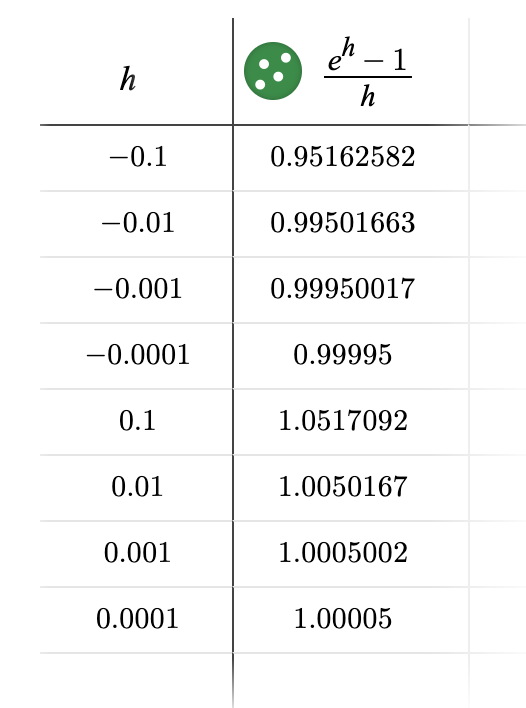
We can clearly see from this table that \(\lim_{h\rightarrow0}\left(\frac{e^h-1}{h}\right)=1\). Making the derivative: \(f'(x)=e^x\cdot1\implies f'(x)=e^x\). A function that equals its own derivative!