Continuity


The concept of when a function is continuous at a point is a critical application of limits.   Informally, a continuous function can be thought of as a function that can be drawn without lifting the pencil off of the paper.   It would show no holes, gaps or breaks in the graph.   However, that is not a valid mathematical definition of a continuous function.   The first part describes what is means to be continuous at a point, and then it is expanded to continuous on an interval \([a,b]\).   The final part described the Intermediate Value Theorem, a critical aspect of limits and continuous functions.


Continuous at a Point \(x=a\).

A function is said to be continuous at \(x=a\) provided there are no holes, gaps or jumps of the function "near" \(x=a\).   It should be no surprise that the term "near" leads to use of limits:

Continuity at a Point

A function \(f\) is continuous at the point \(x=a\) provided:

  1. 1.   \(f(a)\) exists
  2. 2.   \(\lim_{x\rightarrow a}f(x)\) exists
  3. 3.   \(f(a)=\lim_{x\rightarrow a}f(x)\)

A couple of key things to point out from this definition.   Item #1 ensures no "hole" occurs at \(x=a\).   Item #2 implies the limits of both sides exist and are equal:   \(\lim_{x\rightarrow a^-}f(x)=\lim_{x\rightarrow a^+}f(x)\), making sure no "gaps" occur.   Item #3 ensures that no "breaks" occur since the limit must equal the function value.


Example

Determine if the function \(f(x)=|3(x-4)|+2\) is continuous at \(x=4\).

Check if \(f(4)\) exists: \(\begin{array}{l} f(4)=|3(4-4)|+2 \\ f(4)=|3(0)|+2 \\ f(4)=|0|+2 \\ f(4)=2\; \color{green}{\checkmark} \end{array}\)
Check if \(\lim_{x\rightarrow4}f(x)\) exists: As \(x\rightarrow4^-\):   \(\begin{array}{l} \lim_{x\rightarrow4^-}f(x)=\lim_{x\rightarrow4^-}\left(-3(x-4)+2\right) \\ \implies \lim_{x\rightarrow4^-}\left(-3(4-4)+2\right) \\ \implies \lim_{x\rightarrow4^-}\left(-3(0)+2\right) \\ \implies \lim_{x\rightarrow4^-}=2\;\color{green}{\checkmark} \end{array}\)

As \(x\rightarrow4^+\):   \(\begin{array}{l} \lim_{x\rightarrow4^+}f(x)=\lim_{x\rightarrow4^+}\left(3(x-4)+2\right) \\ \implies \lim_{x\rightarrow4^+}\left(3(4-4)+2\right) \\ \implies \lim_{x\rightarrow4^+}\left(3(0)+2\right) \\ \implies \lim_{x\rightarrow4^+}=2\;\color{green}{\checkmark} \end{array}\)

Hence \(\lim_{x\rightarrow4}f(x)\) does exists and equals \(2\).
Does \(f(4)=\lim_{x\rightarrow4}f(x)\)? Since \(f(4)=2\) and \(\lim_{x\rightarrow4}f(x)=2\), then \(f(4)=\lim_{x\rightarrow4}f(x)\;\color{green}{\checkmark}\)

Therefore, \(f\) is continuous at \(x=4\).

Examples of Non-continuous Functions
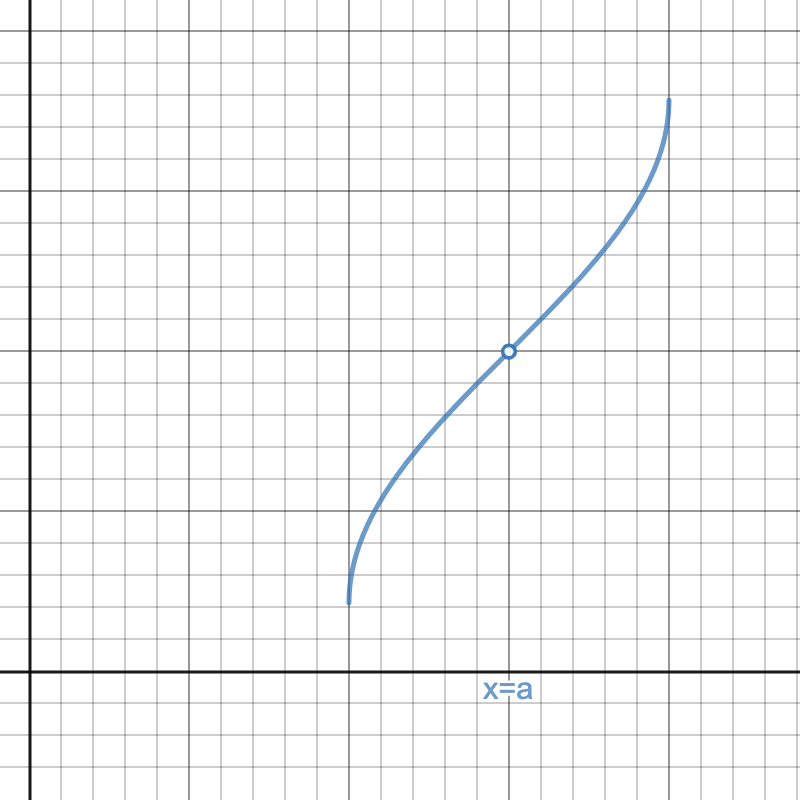
hole in graph

Here the graph shows that \(f\) is not defined at \(x=a\), this shows a "hole", hence the function is NOT continuous at \(x=a\) since \(f(a)\) does not exist.
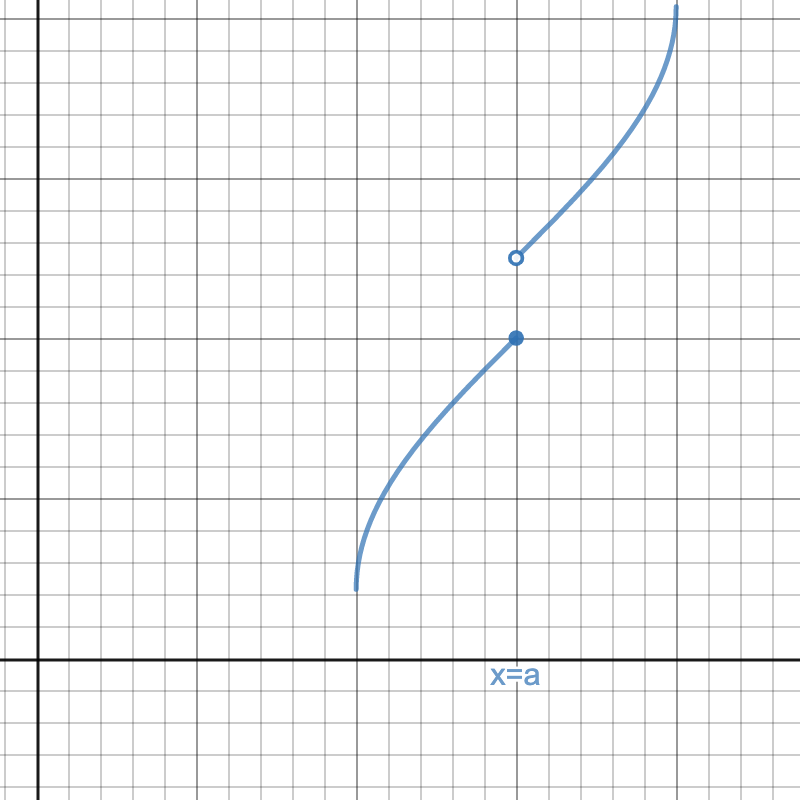
break in graph

Here the graph shows that the left side limit exists, the right side limit exists, but are not equal. Hence the function is NOT continuous at \(x=a\) since \(\lim_{x\rightarrow a}f(x)\) does not exist.
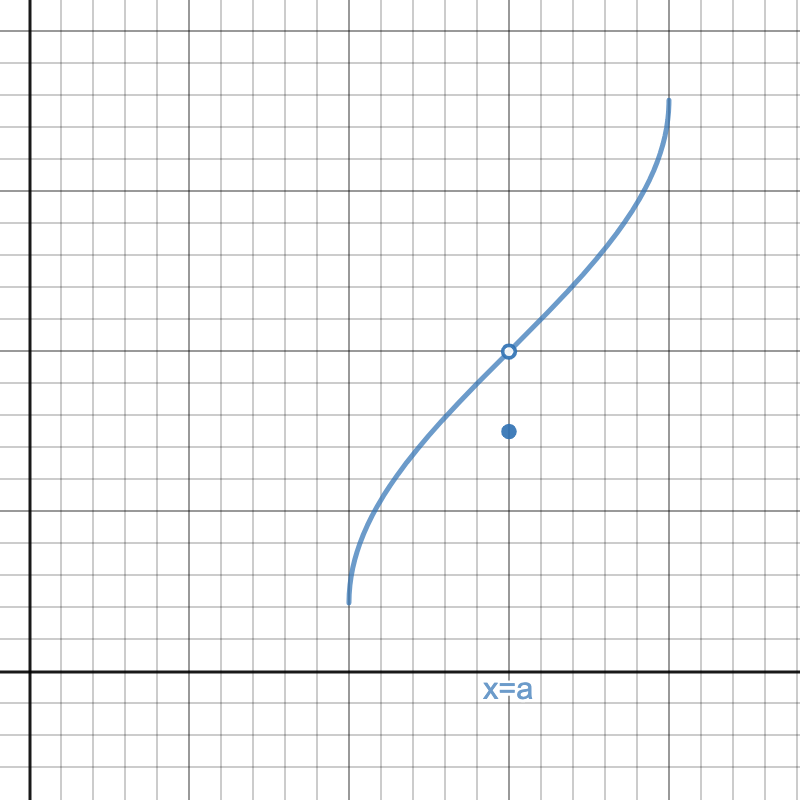
defined but hole in graph

Here the graph shows that \(f\) is defined at \(x=a\) and that \(\lim_{x\rightarrow a}f(x)\) exists (the left-side limit equals the right-side limit). The function is NOT continuous at \(x=a\) since \(f(a)\ne\lim_{x\rightarrow a}f(x)\).
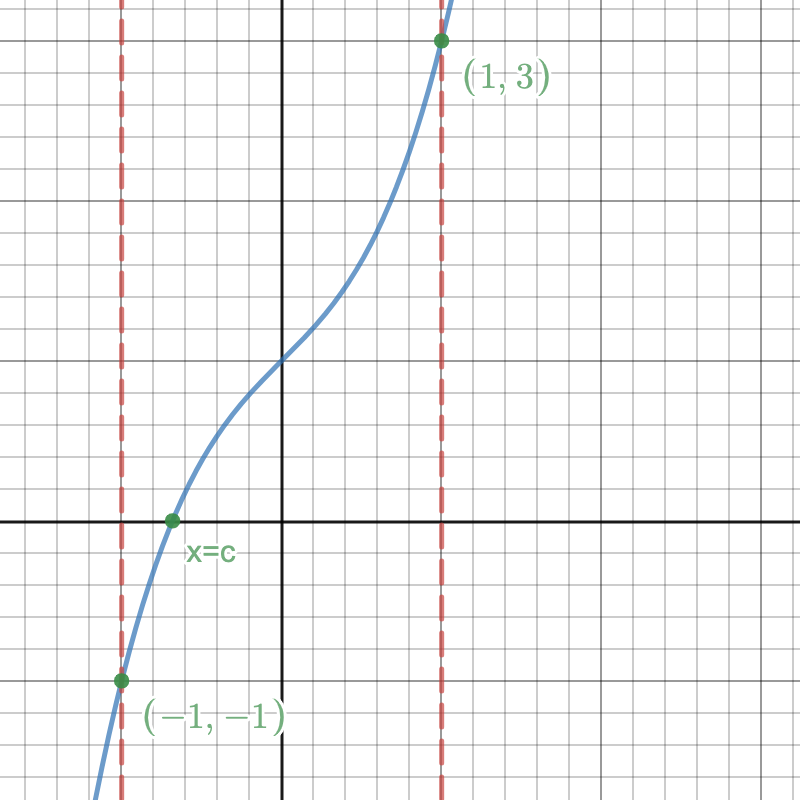

Intermediate Value Theorem

One application of continuous functions is the Intermediate Value Theorem:   if \(f\) is contiuous on \([a,b]\) and \(k\) is any value strictly between \(f(a)\) and \(f(b)\), then there exists at least one value \(c\) in \((a,b)\) where \(f(c)=k\).

Example

Does the function \(f(x)=x^3+x+1\) have a zero on the interval \([-1,1]\)?

Being a polynomial, \(f\) is continuous on the domain \((-\infty,\infty)\).   Evaluate \(f\) at each endpoint: $$\begin{array}{l} f(-1)=(-1)^3+(-1)+1 & \implies f(-1)=-1-1+1 & \implies f(-1)=-1 \\ f(1)=(1)^3+(1)+1 & \implies f(1)=1+1+1 & \implies f(1)=3 \end{array}$$ To be a zero of a function, means \(f(x)=0\), and since \(0\) is strictly between \(-1\) and \(3\), the IVT guarantees there exists a value \(c\) in \((-1,1)\) where \(f(c)=0\).


The IVT is an existence theorem, meaning, the value is guaranteed to exist, but it does not explain how to find the value.   The following graph explains all the parts:

IVT graph