Limits At Infinity


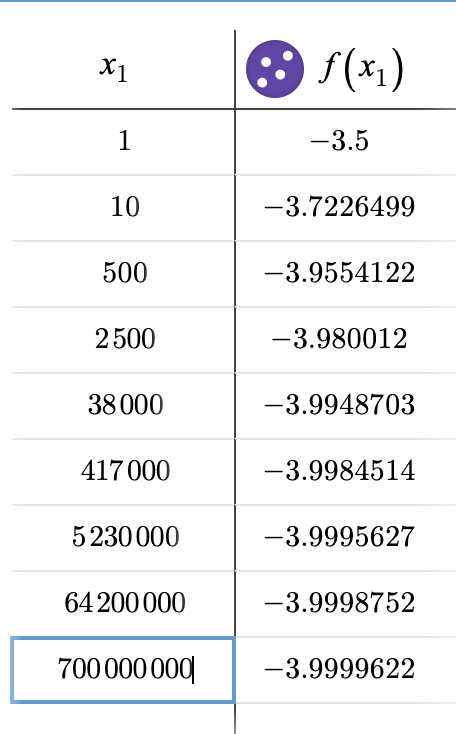
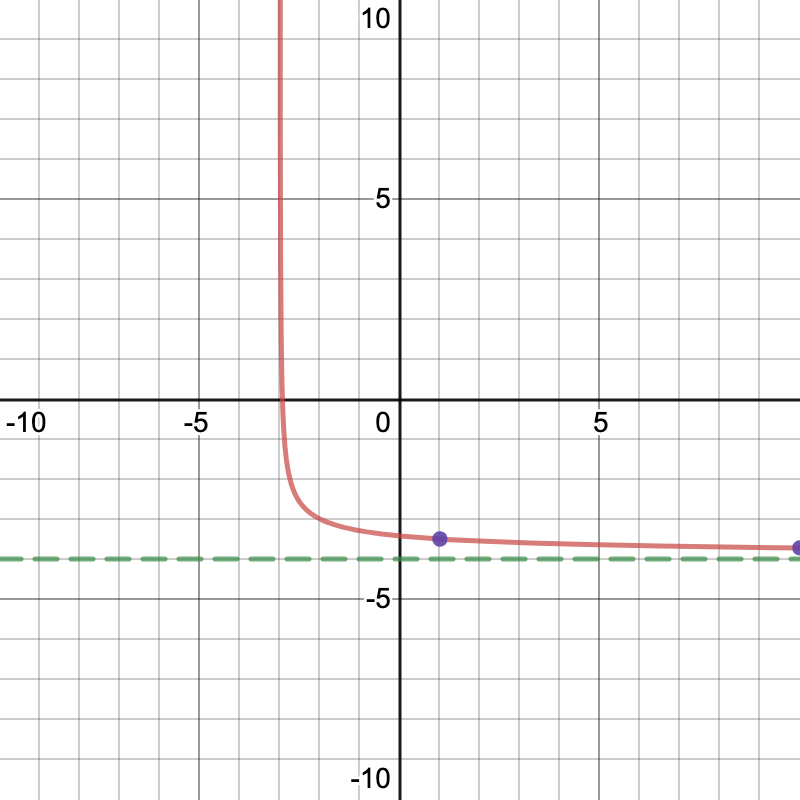
Consider the following function:   \(f(x)=\large{\frac{1}{\sqrt{x+3}-4}\normalsize{+2}}\).   As \(x\) grows without bound, something strange is going on.   The graph and a table are shown below:
graph table

The table shows the function values, \(f(x)\), appear to approach \(-4\) as \(x\rightarrow\infty\).   The graph confirms what the table shows as well.   This graphical feature is called a horizontal asymptote.   This leads to the following definition:

Limits At Infinity & Horizontal Asymptotes
Positive Infinity

If \(f(x)\) becomes arbitrarily close to the number \(L\) for all sufficiently large and positive \(x\)-values, then $$\lim_{x\rightarrow\infty}f(x)=L$$ In this case, the line \(y=L\) is a horizontal asymptote of \(f(x)\).

Negative Infinity

If \(f(x)\) becomes arbitrarily close to the number \(M\) for all sufficiently large and negative \(x\)-values, then $$\lim_{x\rightarrow-\infty}f(x)=M$$ In this case, the line \(y=M\) is a horizontal asymptote of \(f(x)\).
Infinite Limits at Infinity

Many functions have the feature that as \(x\rightarrow\pm\infty\) so do the function values, \(f(x)\rightarrow\pm\infty\).   Power functions and polynomials are the best examples of these features:

power

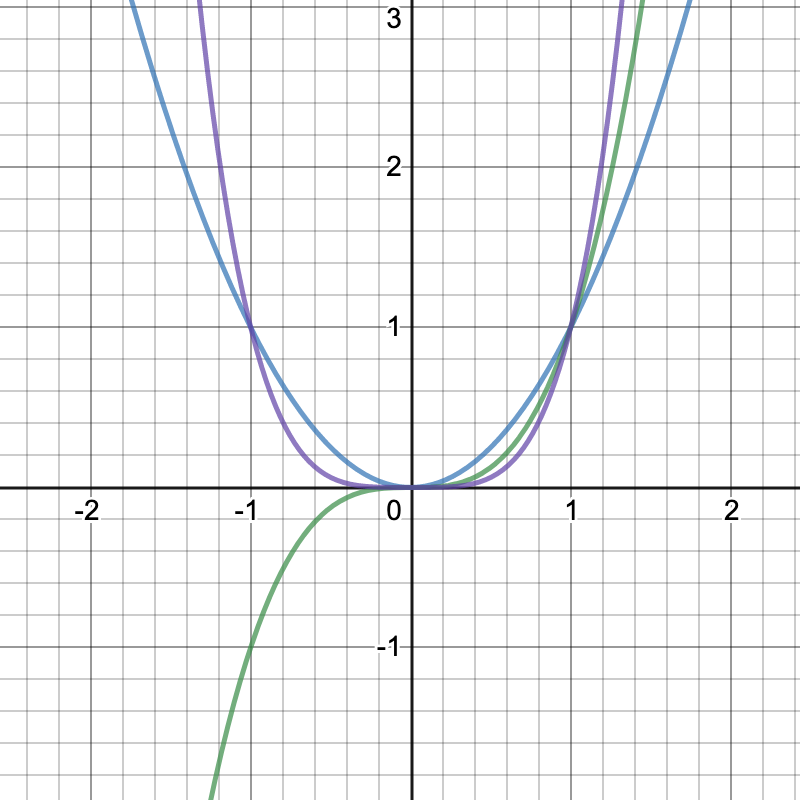
Here are the three basic power functions:   \(\color{blue}{x^2},\;\color{green}{x^3}\) and \(\color{purple}{x^4}\).

Both functions \(x^2\) and \(x^4\) behave in the same fashion:   as \(x\rightarrow\pm\infty\), then \(f(x)\rightarrow\infty\).

However, for \(x^3\), the behavior is slightly different:   as \(x\rightarrow-\infty,\;f(x)\rightarrow-\infty\) and \(x\rightarrow\infty,\;f(x)\rightarrow\infty\).

This is referred to as the ending behavior of these functions, and the same rule applies to the ending behavior of polynomials (an example in the video will discuss this).   In general, the ending behavior depends on the degree \(n\):

\(\lim_{x\rightarrow\pm\infty}x^n=\infty\) when \(n\) is even
\(\lim_{x\rightarrow\infty}x^n=\infty\) and \(\lim_{x\rightarrow-\infty}x^n=-\infty\) when \(n\) is odd
\(\lim_{x\rightarrow\pm\infty}p(x)=\lim_{x\rightarrow\pm\infty}a_nx^n=\pm\infty\) depending on if the degree \(n\) is odd or even, and if \(a_n\) is positive or negative

Slant Asymptotes

One special case on asymptotes to consider are when a slant (or oblique) asymptote exists.   These only occur in rational functions, exactly when the numerator polynomial is of degree one more than the denominator polynomial.   The following examples illustrates this.

Example

Find the slant asymptote of the function \(h(x)=\large{\frac{-8x^3-10x^2+13x+15}{2x^2+5x+4}}\) if it exists.

Since the degree of the top polynomial is \(3\) and the degree of the denominator is \(2\), a slant asymptote exists.

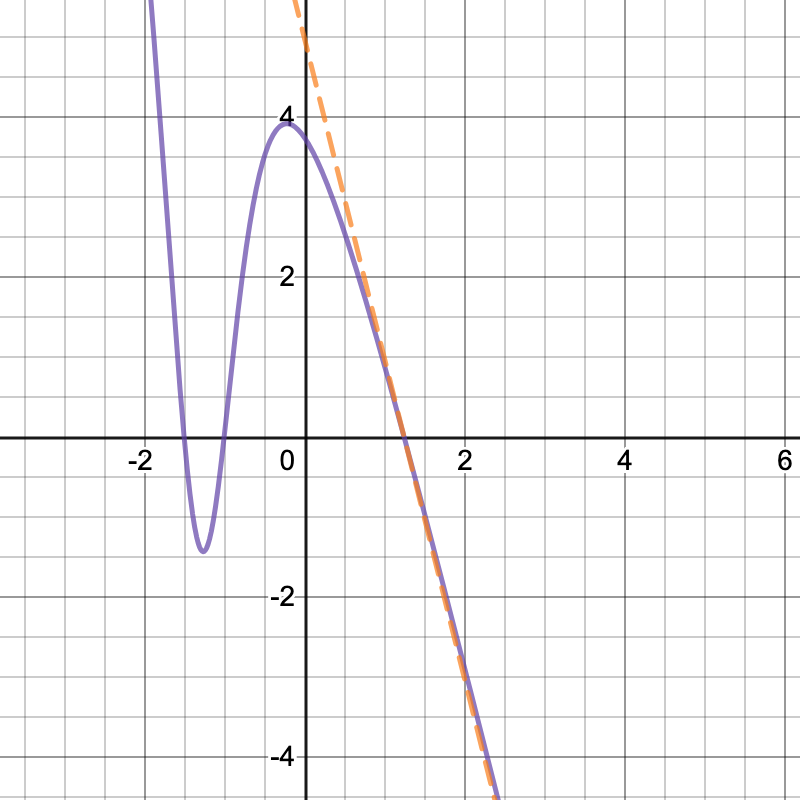
The process to find the slant asymptote, is to perform long division: $$\begin{array}{l} 2x^2+5x+4\;\sqrt{-8x^3-10x^2+13x+15} \\ \\ \implies -4x+5+\large{\frac{4x-20}{2x^2+5x+4}} \end{array}$$ From the requirement that the degree of the numerator is one more than the degree of the denominator, it follows that a line is the slant asymptote.

Hence, as \(x\rightarrow\infty\), \(f(x)\rightarrow -4x+5\).   Could also argue the same for \(x\rightarrow-\infty\).

line asymptote

Examples

.


Some Transcendental Functions

By analyzing graphs and making tables of values, verify the following limits:

\(\lim_{x\rightarrow\infty}e^x=\infty\) \(\lim_{x\rightarrow-\infty}e^x=0\)
\(\lim_{x\rightarrow\infty}e^{-x}=0\) \(\lim_{x\rightarrow-\infty}e^{-x}=\infty\)
\(\lim_{x\rightarrow\infty}\ln x=\infty\) \(\lim_{x\rightarrow0^+}\ln x=-\infty\)