Infinite Limits
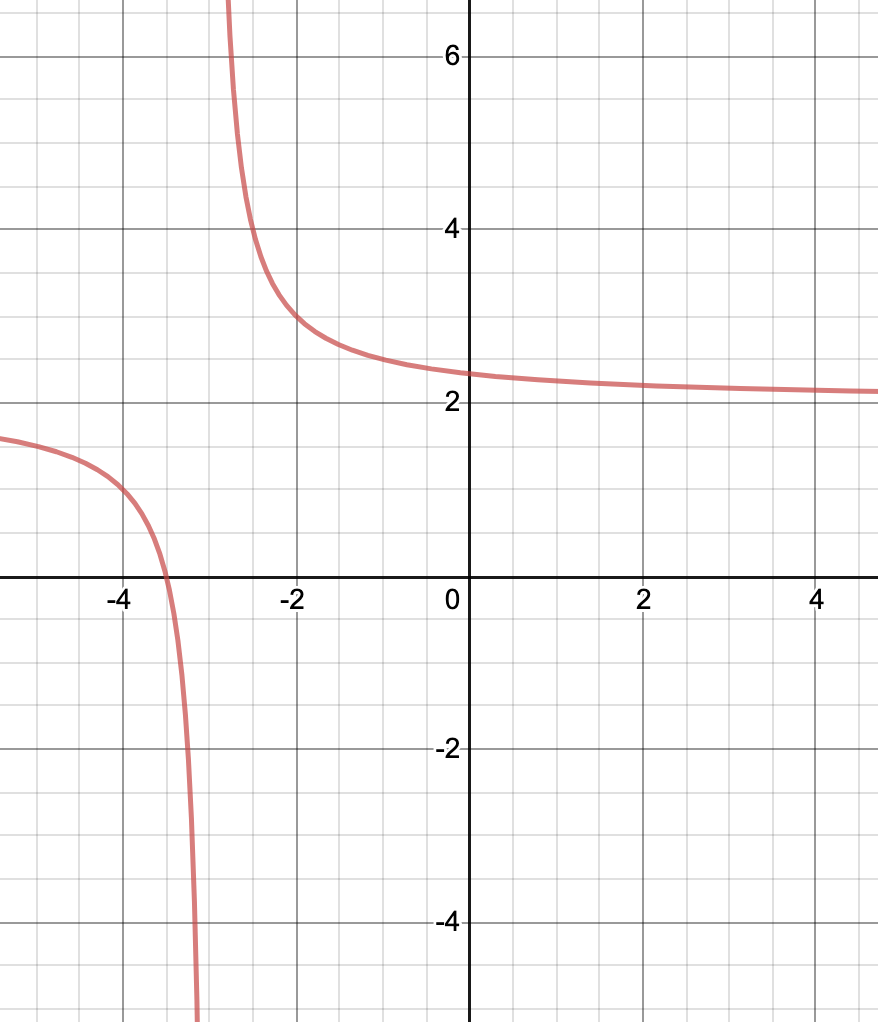
Consider the following function: \(f(x)=\large{\frac{1}{x+3}}\normalsize{+2}\). At \(x=-3\) something strange is going on. The graph and a table are shown below:
 |
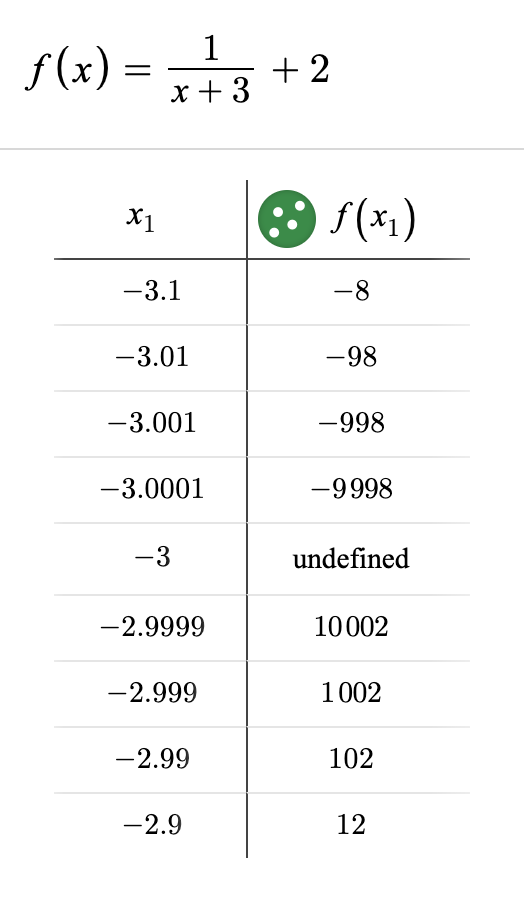 |
From either analyzing the graph or looking at the table, as \(x\rightarrow-3^-\), the function values are getting more and more negative, hence smaller. This behavior is called "approaching negative infinity", meaning the limit Does Not Exist and is expressed as \(\lim_{x\rightarrow-3^-}f(x)=-\infty\).
Likewise, as \(x\rightarrow-3^+\), the function values grow larger and larger, "approach positive infinity", so the limit does not exist and is expressed as \(\lim_{x\rightarrow-3^+}f(x)=\infty\). This type of function behavior is referred to as an infinite limit. This leads to the following definitions:
One-Sided Infinite Limits
Suppose \(f\) is defined for all \(x\) near \(a\) with \(x>a\). If \(f(x)\) grows arbitrarily large for all \(x\) sufficiently close to \(a\), then \(\lim_{x\rightarrow a^+}f(x)=\infty\).
Suppose \(f\) is defined for all \(x\) near \(a\) with \(x< a\). If \(f(x)\) grows arbitrarily large for all \(x\) sufficiently close to \(a\), then \(\lim_{x\rightarrow a^-}f(x)=\infty\).
One-Sided Infinite Limits
Suppose \(f\) is defined for all \(x\) near \(a\) with \(x>a\). If \(f(x)\) grows arbitrarily small for all \(x\) sufficiently close to \(a\), then \(\lim_{x\rightarrow a^+}f(x)=-\infty\).
Suppose \(f\) is defined for all \(x\) near \(a\) with \(x< a\). If \(f(x)\) grows arbitrarily small for all \(x\) sufficiently close to \(a\), then \(\lim_{x\rightarrow a^-}f(x)=-\infty\).
Two-Sided Infinite Limits
Suppose \(f\) is defined for all \(x\) near \(a\). If \(f(x)\) grows arbitrarily large for all \(x\) sufficiently close to \(a\), then \(\lim_{x\rightarrow a}f(x)=\infty\).
Suppose \(f\) is defined for all \(x\) near \(a\). If \(f(x)\) grows arbitrarily small for all \(x\) sufficiently close to \(a\), then \(\lim_{x\rightarrow a}f(x)=-\infty\).
The above definitions, \(\lim_x{\rightarrow a}f(x)=\pm\infty,\;\lim_x{\rightarrow a^-}f(x)=\pm\infty\) and \(\lim_x{\rightarrow a^+}f(x)=\pm\infty\), lead to a graphical interpretation about the line \(x=a\). This tending to infinity as \(x\rightarrow a\) defines a vertical asymptote at \(x=a\)..