Suppose the function \(f\) is defined for all \(x\) very close to \(a\), except possibly at \(a\).   If \(f(x)\) is arbitrarily close to \(L\) for all \(x\) near \(a\), then $$\lim_{x\rightarrow a}\left(f(x)\right)=L"$$ The above statement is read:   "the limit as \(x\) approaches \(a\) of \(f(x)\) is \(L\).
This is a very ackward definition to say the least.   The main point is to consider what the function values are doing as the \(x\)-values are approaching \(a\).   If the function values seem to approach ONE value, then \(L\) is the limit of \(f\).
The following graph and explainations will help understand the ideas of "arbitrarily close" used in the above definition of limits.
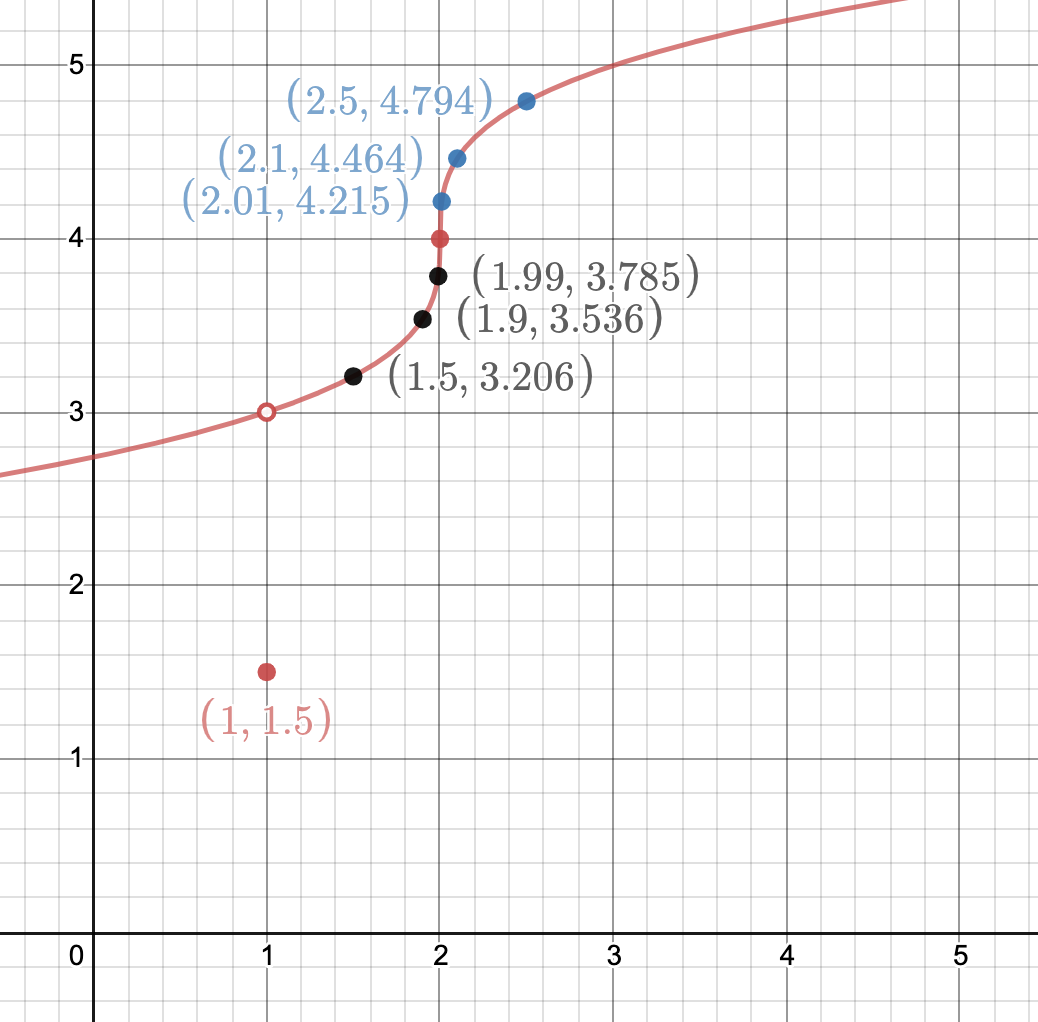
The graph shown has a limit at \(x=2\).   First, as \(x\)-values get closer to \(x=2\) from the "left" side:   \(x=1.5,\;x=1.9,\;x=1.99\), notice how the function values are approaching \(f(x)=4\):   \(3.206,\;3.536,\;3.785\).
Second, as \(x\)-values get closer to \(x=2\) from the "right" side:   \(\color{blue}{x=2.5,\;x=2.1,\;x=2.01}\), notice how the function values are approaching \(f(x)=4\):   \(\color{blue}{4.794,\;4.464,\;4.215}\).
This shows the ideas of \(f(x)\) approaching \(L=4\) as \(x\) approachs \(2\).   This is written as:
$$\lim_{x\rightarrow2}\left(f(x)\right)=4$$
NOTE:   the function is defined at \(x=2\):   \(f(2)=4\), and the value equals the limit of \(4\).
Now consider what is happening to the function values as \(x\) approaches \(1\).   Using the same idea as the black and blue points, it should be clear to see that as \(x\) approaches \(1\), the function values approach \(3\).   Remember to look from both sides, left and right.
This is written as:
$$\lim_{x\rightarrow1}\left(f(x)\right)=3$$
Here, the function is defined at \(x=1\) but the value is NOT equal to the limit:   \(f(1)=1.5\ne3\).
This is showing the part of the definition above "except possibly at \(a\)".
Whether the function is defined at \(a\) is not a factor for a limit value to exist.
The idea of looking on the "right" side and the "left" side leads to another definition:   one-sided limits:
Suppose \(f\) is defined for all \(x\) near \(a\) with \(x> a\).   If \(f(x)\) is arbitrarily close to \(L\) for all \(x\) near \(a\) with \(x> a\), then $$\lim_{x\rightarrow a^+}\left(f(x)\right)$$
Suppose \(f\) is defined for all \(x\) near \(a\) with \(x< a\).   If \(f(x)\) is arbitrarily close to \(L\) for all \(x\) near \(a\) with \(x< a\), then $$\lim_{x\rightarrow a^-}\left(f(x)\right)$$
In the example above, the blue points show a right-sided limit and the black points show a left-sided limit.   Under these new definitions, it would be written as: $$\lim_{x\rightarrow2^+}\left(f(x)\right)=4\;\text{  and  }\;\lim_{x\rightarrow2^-}\left(f(x)\right)=4$$ Here the right side limit and the left side limit agree at the value \(L=4\).   This does NOT always occur.   The following theorem show the relationship between one-sided and two-sided limits:
Assume \(f\) is defined for all \(x\) near \(a\) except possibly at \(a\).   Then $$\lim_{x\rightarrow a}\left(f(x)\right)=L\;\text{  if and only if  }\;\lim_{x\rightarrow a^+}\left(f(x)\right)=L\;\text{  and  }\;\lim_{x\rightarrow a^-}\left(f(x)\right)=L$$
This theorem says that if the two-sided limit exists, then the right-sided limit and the left-sided limit must be equal.   More importantly, when the right-sided limit equals the left-sided limit, then the two-sided limit exists
Consider the following table of values.   Identify any type of limits that exist.
| \(x\) | \(1.5\) | \(1.75\) | \(1.9\) | \(1.99\) | \(1.999\) | \(2.001\) | \(2.01\) | \(2.1\) | \(2.25\) | \(2.5\) |
| \(f(x)\) | \(4.0625\) | \(4.015625\) | \(4.0025\) | \(4.000025\) | \(4.0000003\) | \(1.00075\) | \(1.0075\) | \(1.075\) | \(1.1875\) | \(1.375\) |
The value of interest is \(x=2\).   The table shows values approaching and less than \(2\), and then values approaching and greater than \(2\).   Looking over the function values, as \(x\) approaches \(2\) from the left, the function approaches \(4\).   Then as \(x\) approaches \(2\) from the right, the function approaches \(1\).   This suggest the following one-sided limits: $$\lim_{x\rightarrow2^-}\left(f(x)\right)=4$$ and $$\lim_{x\rightarrow2^+}\left(f(x)\right)=1$$ However, since \(\lim_{x\rightarrow2^-}\left(f(x)\right)\ne\lim_{x\rightarrow2^+}\left(f(x)\right)\), there is no two-sided limit:   \(\implies\lim_{x\rightarrow2}\left(f(x)\right)\) does not exist.