Definition of the Derivative

Recall from the beginning of Chapter 2, the calculations of the average rate of change and the instantaneous rate of change.   In a graphing interpretation, the average rate of change is the slope of a secant line, and the instantaneous rate of change is the limit of these slopes to find the slope of the tangent line.   More precisely, for a function \(f(x)\) on the interval \([a,x]\):

Average Rate of Change \(m_{sec}=\frac{f(x)-f(a)}{x-a}\) slope of secant line
Instantaneous Rate of Change \(m_{tan}=\lim_{x\rightarrow a}\frac{f(x)-f(a)}{x-a}\) slope of tangent line

Example

Let \(f(x)=-16x^2+96x\) and consider the point \(P(1,80)\) on the curve.   Find the slope of the line tangent to the graph of \(f\) at \(P\).   Then find an equation of the tangent line there.


Alternative Formulas

Instead of looking at values where \(x\rightarrow a\), let \(h\) represent the distance \(x\) is from \(a\), \(x=a+h\).   Then as \(x\) gets close to \(a\), this makes \(h\rightarrow0\).   Now the instantaneous rate of change becomes: $$m_{tan}=\lim_{h\rightarrow 0}\frac{f(a+h)-f(a)}{a+h-a}\implies\lim_{h\rightarrow 0}\frac{f(a+h)-f(a)}{h}$$ Hopefully, this looks familiar to you, it is the Difference Quotient discussed back in Chapter 1!   We can look differently at our example now by considering \(a=1\) and use this alternate formula:

Example

Let \(f(x)=-16x^2+96x\) and consider the point \(P(1,80)\) on the curve.   Use the alternative formula to find the slope of the tangent line at \(P\).


Derivative as a Function

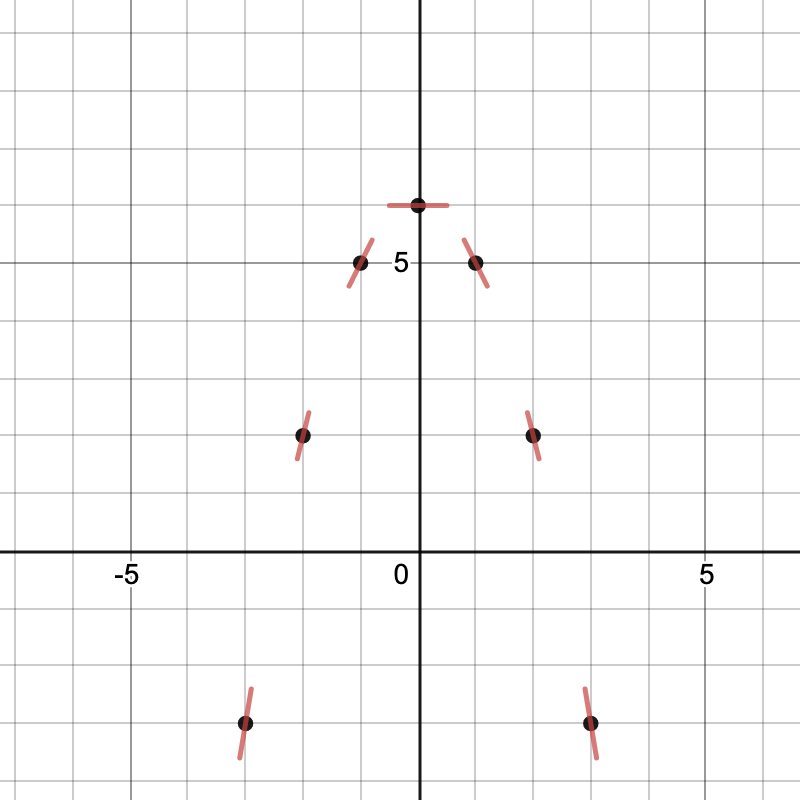
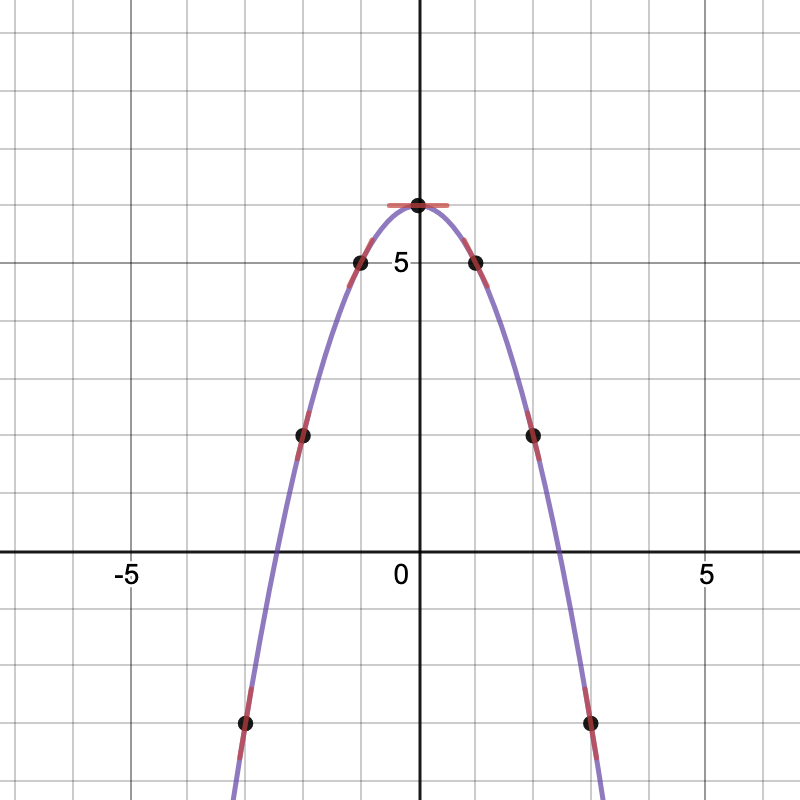
Consider the following graphs:
DerivOver DerivOnly

The graph on the left is a function with tangent line segments at certain points.   The graph on the right is just the tangent line segments with the function removed.   Whenever a tangent line exists at a point, the \(x\)-value can be associated with the slope of that tangent line.   Since it is a tangent line, that slope is unique for that \(x\)-value, creating a new function called the derivative.   The common notation for the derivative is \(f^\prime(x)\).   Together with limits, we define the derivative of a function \(f(x)\) to be: $$f^\prime(x)=\lim_{h\rightarrow0}\left(\frac{f(x+h)-f(x)}{h}\right)$$ provided the limit exists for each \(x\) in the domain of \(f\).   This is the algebraic method of finding the derivative of a function.

Example

Find the derivative for \(f(x)=-16x^2+96x\).


Derivative Notations

Next to the standard notation for derivative, \(f^\prime(x)\), there are other useful notations that will appear later on: $$\frac{dy}{dx};\;\frac{d}{dx}\left(f(x)\right);\;D_x\left(f(x)\right);\;y^\prime(x)$$ When we need to evaluate the derivative at a value like \(x=a\), then you might see: $$f^\prime(a);\;y^\prime(a);\;\frac{df}{dx}\Bigg\lvert_{x=a};\;\frac{dy}{dx}\Bigg\lvert_{x=a}$$

Example

Find \(f^\prime(1)\) using the function \(f(x)=-16x^2+96x\).

From the preceeding example, \(f^\prime(x)=-32x+96\) Hence \(f^\prime(1)=-32(1)+96\implies f^\prime(1)=-32+96\implies f^\prime(1)=64\;\color{green}{\checkmark}\)
To see the alternative notation used: \(\large{\frac{df}{dx}}\normalsize{\Bigg\lvert_{x=1}=64}\)