Derivatives & Graphs
There is a strong relationship between the graph of a function and the derivatives of that function. A lot of key features of the graph can be obtained by analyzing the graph, but what about making a more precise understanding? This section will demonstrate how the first and second (and other) derivatives make precise where these key features occur
Increasing & Decreasing
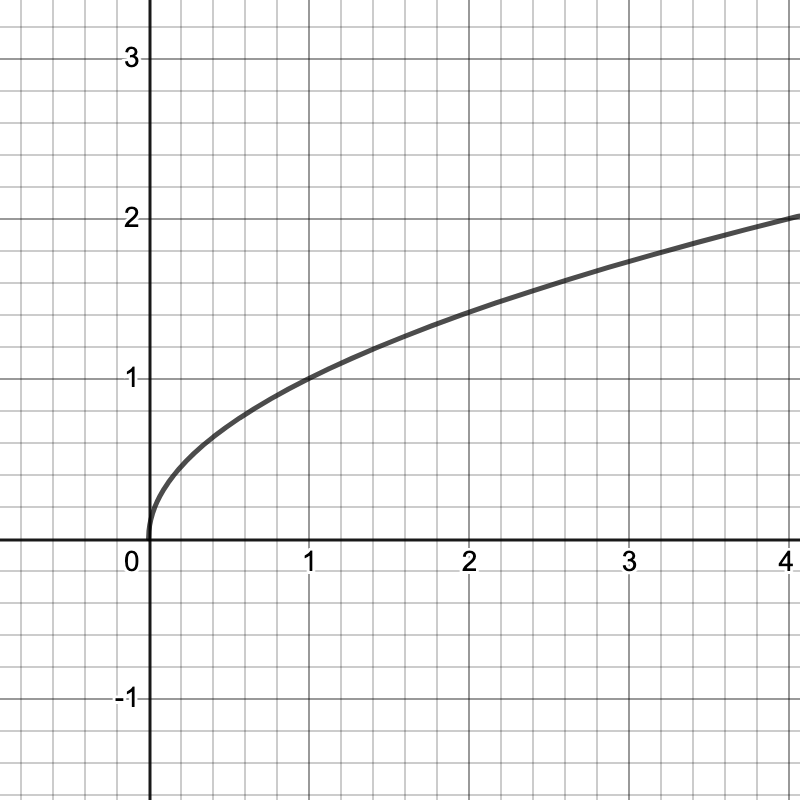
A function is said to increase on an interval if \(f(x_2)>f(x_1)\) whenever \(x_2>x_1\), when \(x_1,x_2\) are in the interval. This is the precise language that is saying as the graph moves left to right, the function values are getting larger, hence the idea of "increase" (a similar definition holds for decreasing). The following table shows and example, and relates to the derivative by looking at tangent lines.
 |
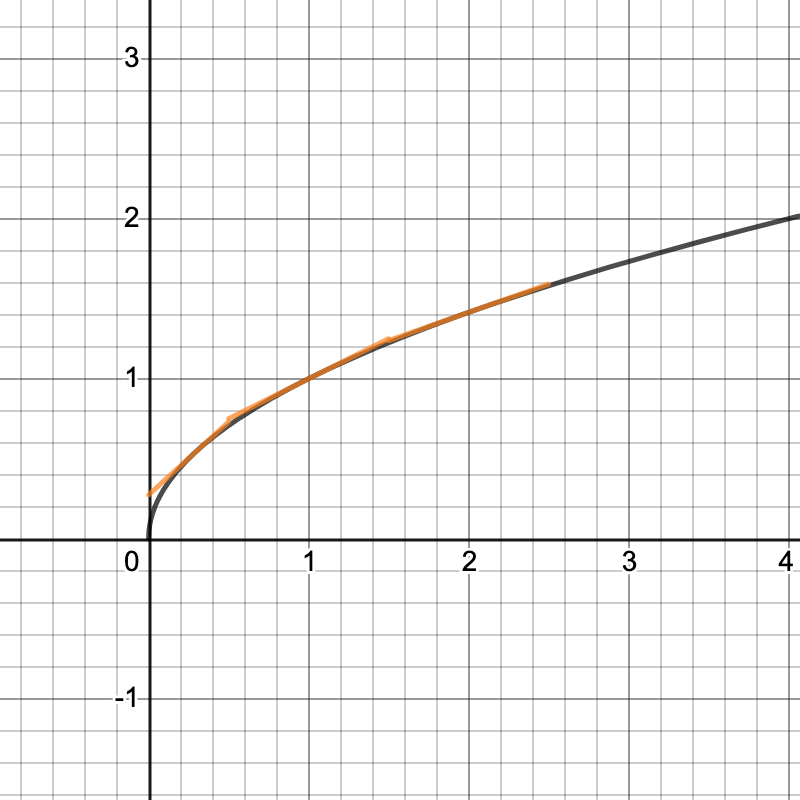 |
| Function increasing on \(I\) | Tangent lines drawn on \(I\) |
In the above example, notice that the three tangent lines all have a positive slope. This means that on the interval \(I\), it must be true that \(f^\prime(x)>0\). The same can be said of when a function is decreasing on \(I\): \(f^\prime(x)< 0\).
Example
Find the intervals on which the function is increasing and decreasing: \(f(x)=2x^3+3x^2+1\).
First, find the critical points by setting the derivative equal to zero: \(f^\prime(x)=6x^2+6x\implies 6x(x+1)=0\implies x=0,\;x=-1\) are the critical points.
Now the domain is split into the following intervals: \((-\infty,-1),\;(-1,0)\) and \((0,\infty)\). To determine is \(f^\prime\) is positive or negative on each interval, select a test point:
- \((-\infty,-1):\;x=-2\implies f^\prime(-2)=12>0\) so \(f\) is increasing on \((-\infty,-1)\)
- \((-1,0):\;x=-\frac{1}{2}\implies f^\prime(-\frac{1}{2})=-\frac{3}{2}< 0\) so \(f\) is decreasing on \((-1,0)\)
- \((0,\infty):\;x=1\implies f^\prime(1)=12>0\) so \(f\) is increasing on \((0,\infty)\)
First Derivative Test
Using the ideas about increasing and decreasing helps to provide classification on local extrema. If \(x=c\) is a critical point, \(f^\prime(c)=0\), then when \(f\) changes from increasing to decreasing, or when \(f\) changes from decreasing to increasing, a local extrema exists. Since the derivative can determine intervals where the function is increasing or decreasing, the following theorem is called the First Derivative Test:
First Derivative Test
Let \(f\) be continuous and differentiable on an interval containing a critical point at \(x=c\).
- If \(f^\prime\) changes sign from positive to negative around \(x=c\), then \(f\) has a local maximum at \(x=c\).
- If \(f^\prime\) changes sign from negative to positive around \(x=c\), then \(f\) has a local minimum at \(x=c\).
- If \(f^\prime\) is positive, or negative, on both sides around \(x=c\), then \(f\) does NOT have a local extrema at \(x=c\).
Example
Find the critical points of \(f(x)=\large{\frac{x^2}{x^2-1}}\) on \([-4,4]\). Use the First Derivative Test to determine the local extrema.
| Need the derivative, use of Quotient Rule: | \(\displaystyle{f^\prime(x)=\frac{2x(x^2-4)-x^2(2x)}{\left(x^2-4\right)^2}\implies f^\prime(x)=\frac{-8x}{\left(x^2-4\right)^2}}\) |
| Set equal to zero: | \(\displaystyle{\begin{array}{l} \large{\frac{-8x}{\left(x^2-4\right)^2}}\normalsize{=0} \\ \implies -8x=0 \\ \implies x=0 \end{array}}\) |
| Find any undefined points: | \(\displaystyle{\begin{array}{l} f^\prime(x)=\large{\frac{-8x}{\left(x^2-4\right)^2}} \\ \implies (x^2-4)^2=0 \\ \implies x^2-4=0 \\ \implies x=\pm2\end{array}}\) |
| Test for sign changes: |
|
| The only change of sign is at \(x=0\), changing from positive to negative, hence the First Derivative Test classifies \(x=0\) as a local maximum of \(f\) on any interval containing \(0\). The critical point \(x=-2\) is positive on both sides, and the critical point \(x=2\) is negative on both sides, hence by the First Derivative Test will NOT have local extrema. | |
Concavity & Inflection Points
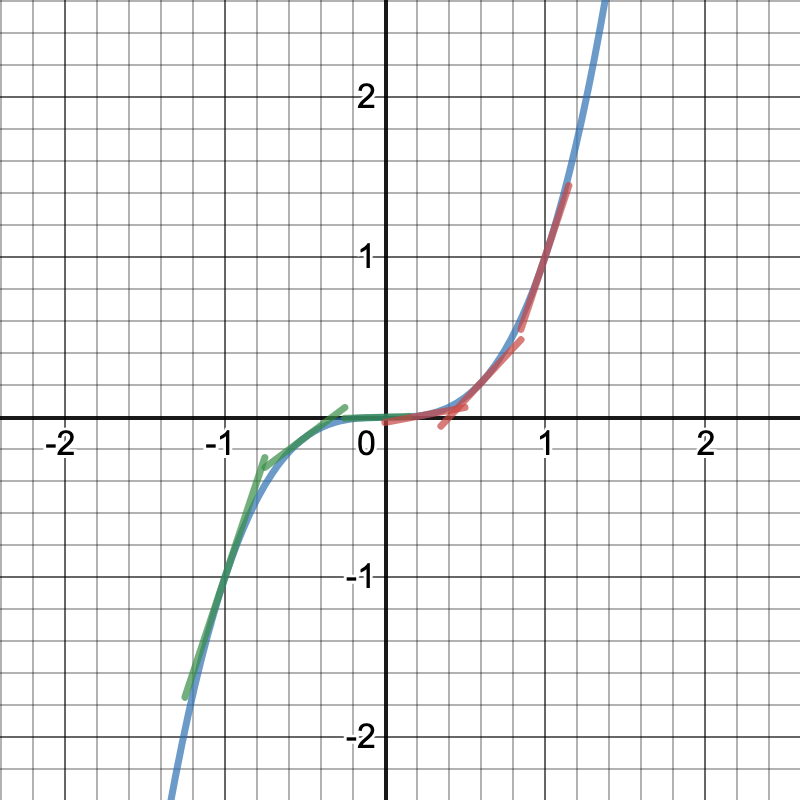
In the graph at the right, notice how the function is always increasing. So the slopes of the tangent lines are all positive values.
First, the green tangent lines have slopes that are getting smaller as \(x\) moves closer to \(0\). This behavior causes the function to "bend" in a downward fashion. This behavior is called concave down.
Second, the red tangent lines have slopes that are getting larger as \(x\) moves away from \(0\). This behavior causes the function to "bend" in an upward fashion. This behavior is called concave up.
The origin, is a point where the function is changing its concavity. When a function changes concavity at a point, that point is called an inflection point.
Using all the above ideas, the derivative of the derivative, aka the second derivative of \(f\), can determine intervals where \(f^\prime\) is increasing or decreasing. Knowing where \(f^\prime\) is increasing and decreasing will determine intervals where \(f\) is concave up or concave down. This is called the Concavity Test.
Concavity Test
Let \(f^{\prime\prime}\) exist on an open interval \(I\).
- If \(f^{\prime\prime}>0\) on \(I\), then \(f\) is concave up on \(I\).
- If \(f^{\prime\prime}< 0\) on \(I\), then \(f\) is concave down on \(I\).
- If \(x=c\) is a point of \(I\) where \(f^{\prime\prime}\) changes sign, then \(f\) has an inflection point at \(x=c\).
Example
Determine the intervals on which \(f\) is concave up or concave down. Identify any inflection points if they exist: \(f(x)=2x^2\ln x-5x^2\).
| Find the first derivative (Product Rule): | \(\begin{array}{l} f^\prime (x)=4x\cdot\ln x+2x^2\left(\frac{1}{x}\right)-10x \\ \implies f^\prime(x)=4x\ln x-8x \end{array}\) |
| Find the second derivative (Product Rule): | \(\begin{array}{l} f^{\prime\prime}(x)=4\ln x+4x\left(\frac{1}{x}\right)-8 \\ \implies f^{\prime\prime}(x)=4\ln x-4 \end{array}\) |
| Set equal to zero: | \(\begin{array}{l} 4\ln x-4=0 \\ \implies 4(\ln x-1)=0 \\ \implies \ln x-1=0 \\ \implies \ln x=1 \\ \implies x=e \end{array}\) |
| Test intervals for positive / negative: | \(\begin{array}{l} (-\infty,e)\;x=1\implies f^{\prime\prime}(1)=-4< 0 \\ (e,\infty)\;x=3\implies f^{\prime\prime}(3)\approx0.3944...>0 \end{array}\) |
| On \((-\infty,e)\;f\) is concave down since \(f^{\prime\prime}< 0\). On \((e,\infty)\;f\) is concave up since \(f^{\prime\prime}> 0\). Since \(f^{\prime\prime}\) changes sign at \(x=e\), this is a point of inflection for \(f\). | |