Introduction


Integrals have been used to find the area of two-dimensional regions between curves.   Now an extension applies to find the volume of a three-dimensional solid.   The idea of partitioning an interval, "slice", finding the area of the cross section two-dimensional shape, and then adding up all these areas, "sum", generates the general formula.

General Slicing Method


Suppose a solid object extends from \(x=a\) to \(x=b\) and the cross section of the solid perpendicular to the \(x\)-axis has an area given by a function \(A\) that is integrable on \([a,b]\). The volume of the solid is

\(V=\int_a^bA(x)dx\)


The key step is to draw the cross section perpendicular to the base of the solid.   Then determine the function that gives the area of the cross section.


Example

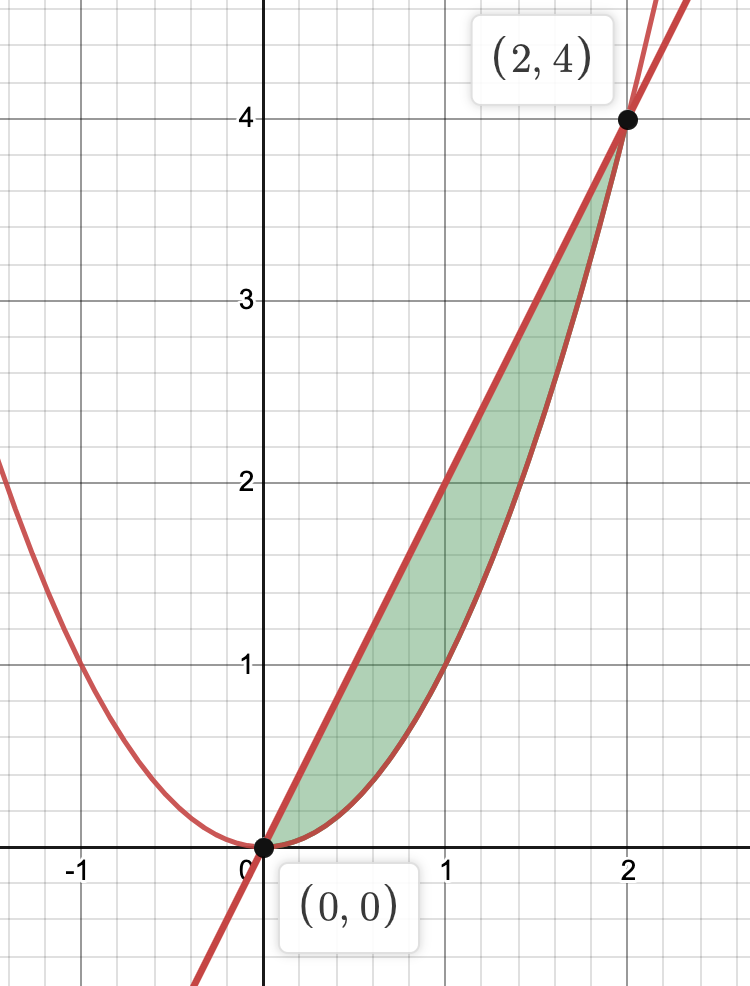
The region bounded by the curves \(y=2x\) and \(y=x^2\) is the base of a solid. Find the volume of the solid if the cross section shape perpendicular to the \(x\)-axis is a square.
ex1graph

The green region is the base of the solid.   By observing the graph, the intersection points are at \((0,0)\) and \((2,4)\).   Alternatively, solving the equation:   \(2x=x^2\) will yield the same \(x\)-values.

Slices are perpendicular to the \(x\)-axis, so that means the "side" of one square is \(2x-x^2\).   The area of a square is given by the side squared, hence the volume integral is as follows:

\(\displaystyle{V=\int_0^2\left(2x-x^2\right)^2dx}\)

\(\displaystyle{\begin{array}{l} \implies \frac{4}{3}x^3-x^4+\frac{1}{5}x^5 \Bigg|_0^2 \\ \implies \frac{4}{3}(2)^3-(2)^4+\frac{1}{5}(2)^5 \\ \implies \frac{16}{15}\;\color{green}{\checkmark} \end{array}}\)

Example #2

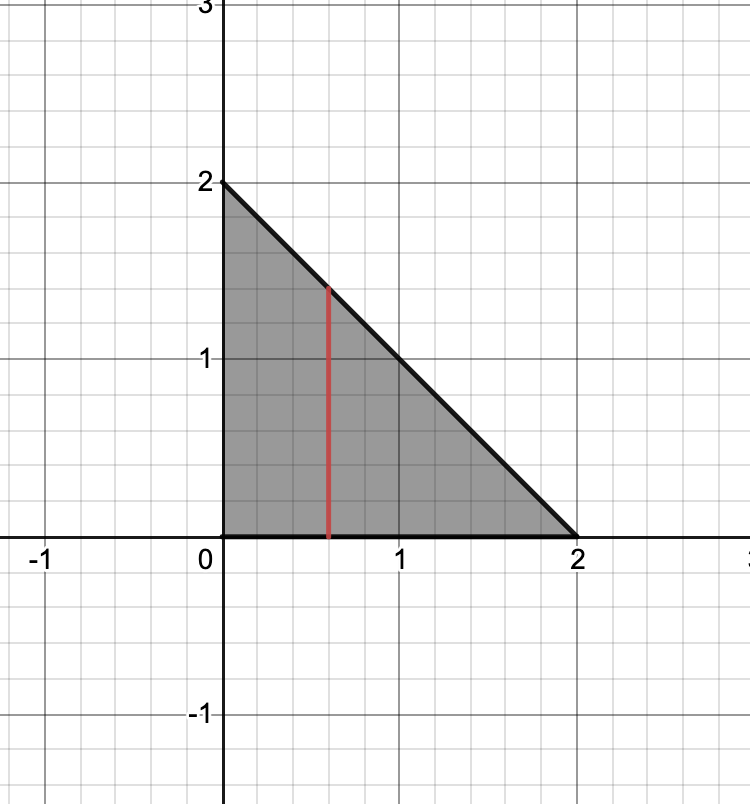
Find the volume of the solid whose base is the triangle with vertices \((0,0),\;(2,0)\) and \((0,2)\). The cross sections perpendicular to the base and parallel to the \(y\)-axis are semicircles.

The triangle is bounded by the line passing through \((2,0)\) and \((0,2)\) and the \(x\)-axis.   The perpendicular slice (red line) gives the radius for the semicircle that has an area found by

\(\displaystyle{A(x)=\frac{\pi}{2}r^2}\)

Traditional slope calculation and with the \(y\)-intercept at \((0,2)\), the equation for the line is \(y=2-x\), forming the radius of the semicircle.   The vertical slices go from \(x=0\) out to \(x=2\), so the volume is defined by the definite integral

\(\displaystyle{\int_0^2 \frac{\pi}{2}(2-x)^2dx}\)

Using the Fundamental Theorem of Calculus to evaluate:

\(\displaystyle{\begin{array}{l} \implies \frac{\pi}{2}\left(4x-2x^2+\frac{1}{3}x^3\right.\bigg|_0^2 \\ \implies \frac{4\pi}{3}\;\color{green}{\checkmark}\end{array}}\)

triangle example