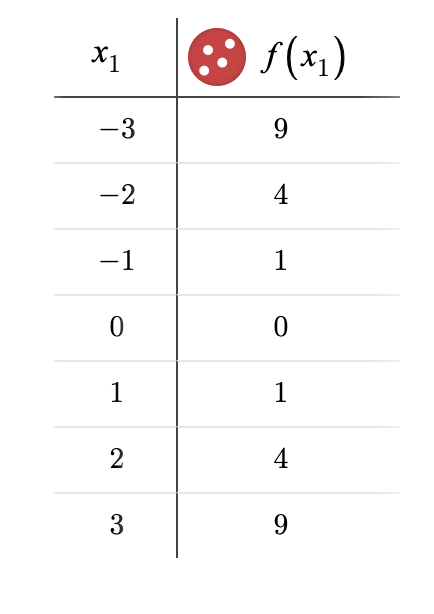
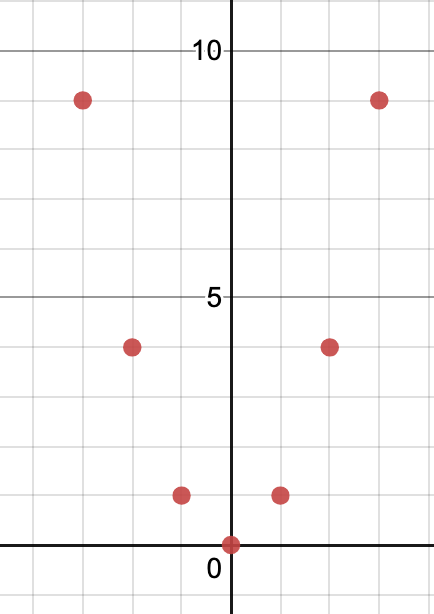
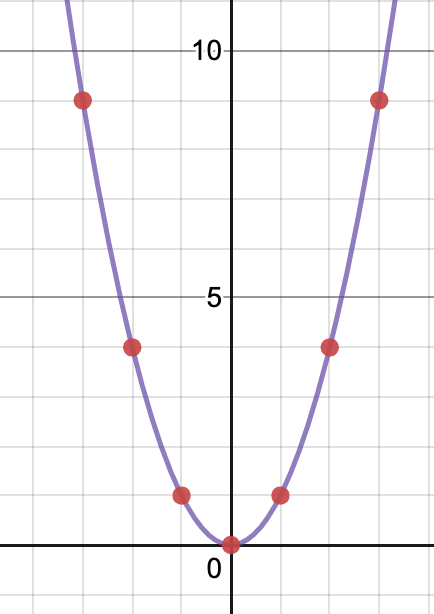
Introduction:
These trinomials are unique functions that have many properties to explore. A quadratic function is in standard form when written as \(f(x)=ax^2+bx+c\). When graphed, the graph takes on the shape called a parabola, and the graph has many key features. The following video will outline all those key features.
Example
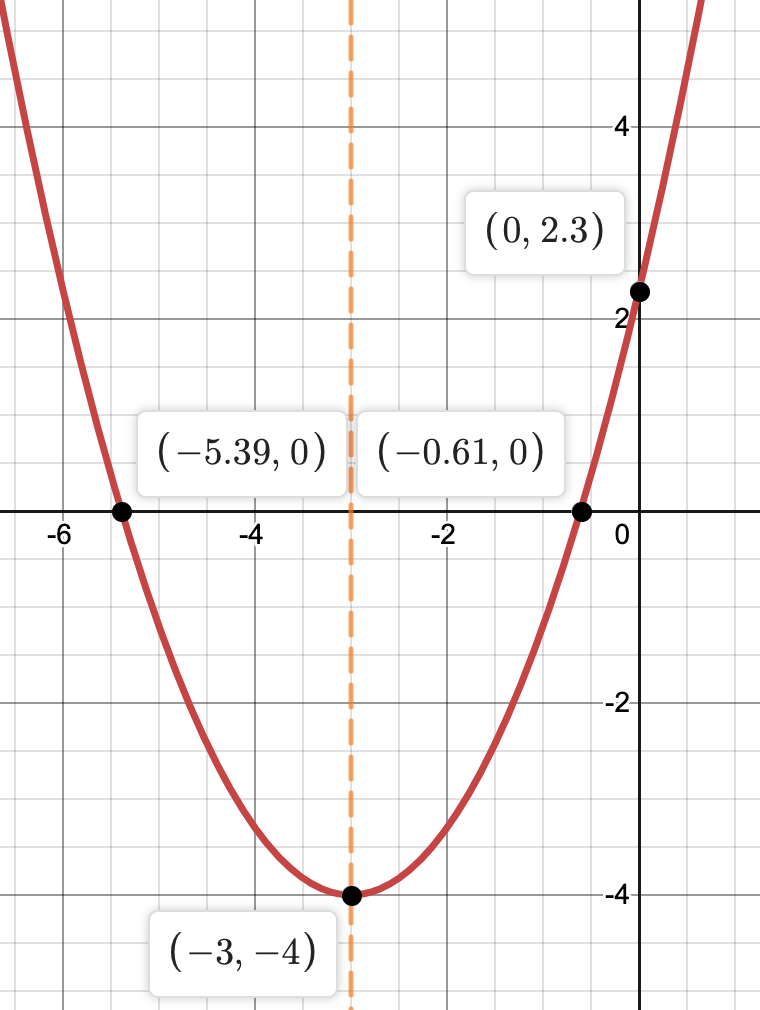
The graph on the right shows a parabola with key features identified as follows:
- the vertex at \((-3,-4)\)
- the \(y\)-intercept at \((0,2.3)\)
- two \(x\)-intercepts at \((-5.39,0)\) and \((-0.61,0)\)
- the axis of symmetry with equation \(x=-3\).
- the domain is all real numbers, or \((-\infty,\infty)\)
- the range is \([-4,\infty)\)
KEYS
- Remember to always put \((0,\#)\) for \(y\)-intercepts
- Remember to always put \((\#,0)\) for \(x\)-intercepts
- The domain defines all the \(x\)-values allowed on the graph. For parabolas, it will always be \((-\infty,\infty)\) unless restricted by a word problem.
- The range defines all the \(y\)-values allowed on the graph. The value of \(k\) from the vertex defines this:
- \(a > 0\) parabola opens up, so range will be \([k,\infty)\)
- \(a < 0\) parabola opens down, so range will be \((-\infty,k]\)