Examples
#1 - During a round of golf, Kayley hits her ball out of a sand trap. The height of the golf ball is modeled by the equation: \(h(t)=-16t^2+20t-4\), where \(h\) is the height of the ball in feet and \(t\) is the time in seconds since the ball was hit. Find how long it takes Kayley's golf ball to hit the ground.
| KEY: Ball hits the ground means \(h(t)=0\): | Solve the equation: \(-16t^2+20t-4=0\) |
| Solve using ANY method: | METHOD: Factoring: \(-16\cdot-4=64\) and factors that add to \(20t\Rightarrow 16t,\;4t\) $$\begin{array}{l} -16t^2+20t-4=0 \\ \implies (t-1)(-16t+4)=0 \\ \implies t=1,\;t=\frac{-4}{-16}=\frac{1}{4} \end{array}$$ |
| Interpret the results: | There are two different time values of \(t=0.25\) and \(t=1\) seconds when the golf ball "hits" the ground. The first value of \(t=0.25\) is when the golf ball has left the sand trap and is "passing" the ground. Being in the sand trap is below the ground as evidenced by the \(-4\) in the model equation. So the correct answer for the ball hitting the ground is 1 second. |
#2 - The rate at which a bear population grows in a park is given by the equation \(P(b)=0.001b(100-b)\). The function value \(P(b)\) represents the rate at which the population is growing in bears per year, and \(b\) is the number of bears.
- a. What is the maximum number of bears the park can support?
- b. Solve \(P(b)=0\) and provide a real-world meaning for these solutions.
#3 - Suppose you have 24 meters of fencing to use and enclose a rectangluar space for a vegetable garden. Naturally, you want to have the largest area possible for your vegetables. What dimensions should you use for your garden?
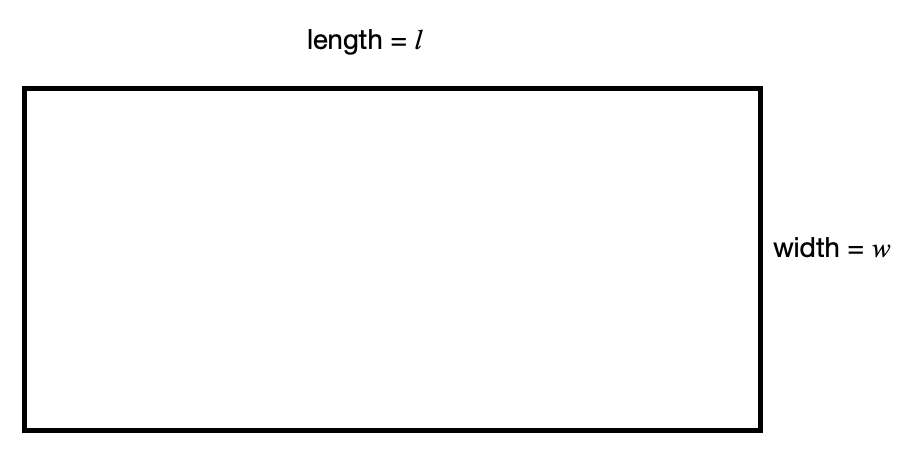
We must build the model equation for this problem.
The area of the garden would be modeled by: \(A=l\cdot w\). However, this has two variables. We need to use the 24 meters of fencing to relate \(l\) and \(w\). Since the garden is a rectangle, there are two lengths and two widths. Solving for the length:
$$2l+2w=24\implies 2l=24-2w\implies l=\frac{24-2w}{2}\implies l=12-w$$
Now the area model equation becomes: \(A=(12-w)w\implies A=12w-w^2\).
If \(w=0\) or \(w=12\), then no rectangle exists since \(A=0\). The maximum width allowed must be at the vertex: $$h=\frac{-b}{2a}\implies h=\frac{-12}{2(-1)}\implies h=6$$ When the width is 6 meters, then \(l=12-6\implies l=6\) meters also. Using 24 meters of fencing, the dimensions of the garden are 6 meters by 6 meters.