Algebra 1 - System of Linear Inequalities

Introduction:

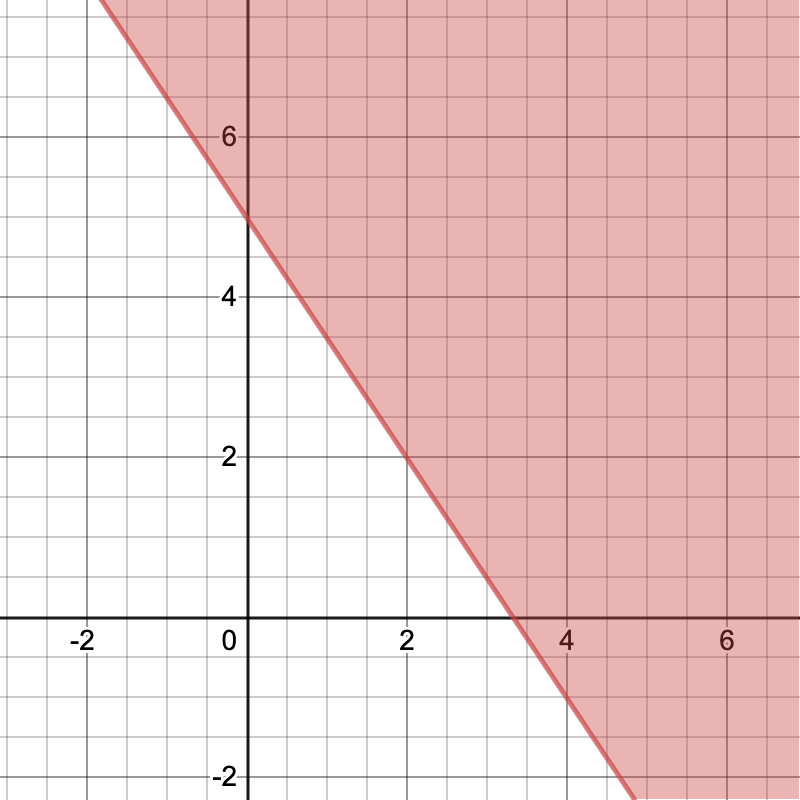
REVIEW:   Consider the linear inequality  \(y\ge-\frac{3}{2}+5\).   As discussed in the previous lesson, the solution is a solid line with \(y\)-intercept at \((0,5)\) and negative slope of down \(3\), right \(2\) and the shaded region above this line:
graph1

A system of linear Inequalities is when two linear inequalities are considered at the same time.   Since each linear inequality will have a solid or dotted line and a shaded region, the solutions to the system must be all points in BOTH shaded regions and on any solid lines.   Use of Desmos to determine the correct shaded region will be helpful.

Example

Determine the solution the the system:   \(y\le\frac{1}{2}x\)   or   \(2x+y>2\).

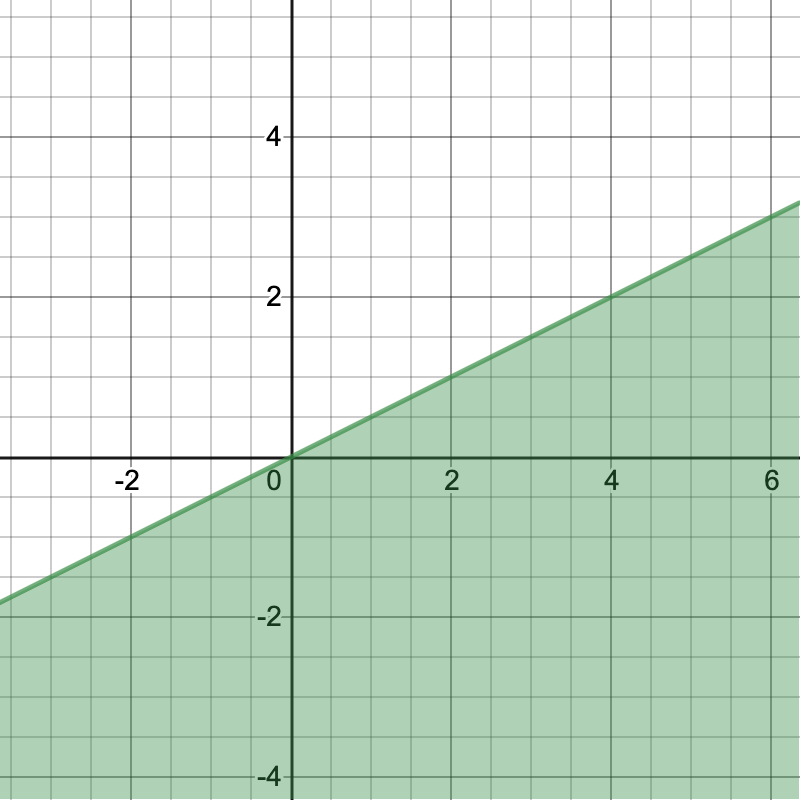
The first linear inequality is a solid line that passes through \((0,0)\) and is shaded below.

NOTE:   \((0,0)\) could NOT be used as a test point since the line passes through \((0,0)\).

graph2

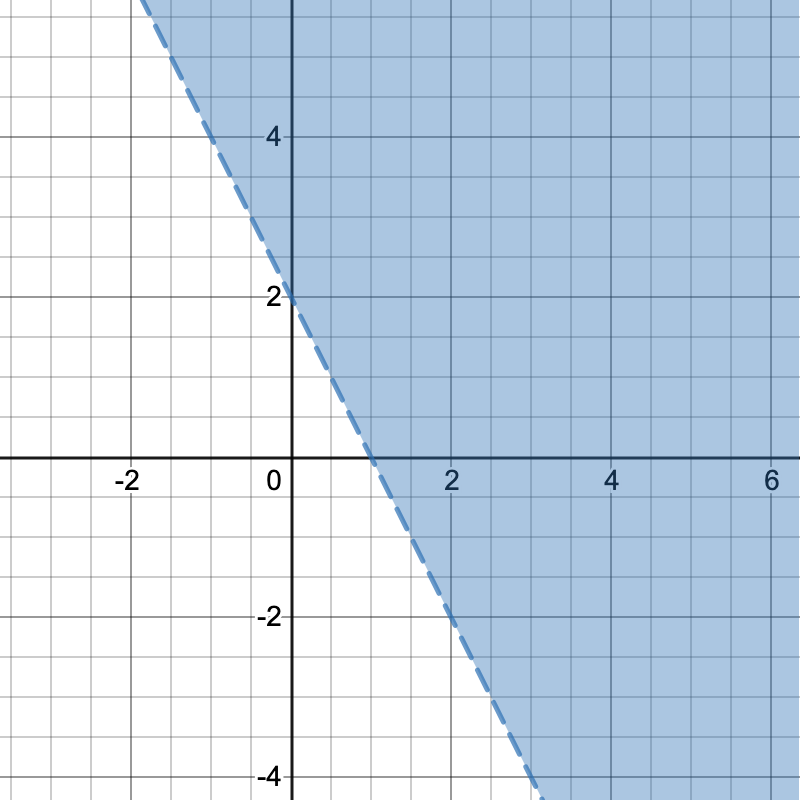
The second linear inequality is a dotted line that passes through the \(x\)-intercept of \((1,0)\), the \(y\)-intercept of \((0,2)\) and is shaded above.

graph3

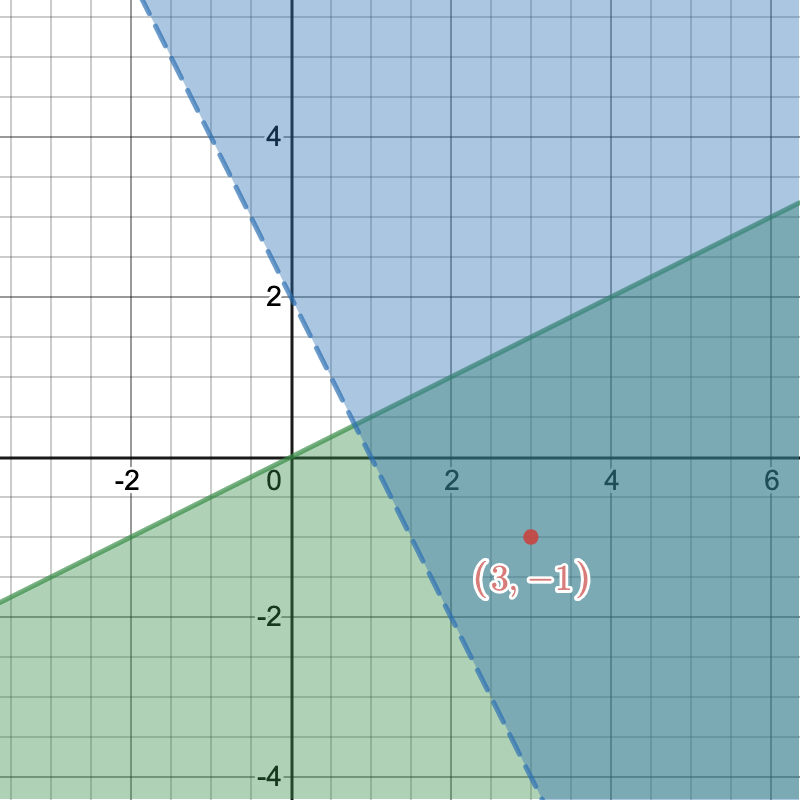
When these two linear inequalities are put on the same graph, the shaded regions overlap.   This overlap region shows all the solutions to the system:

graph4

The point \((3,-1)\) is in the overlapping shaded region, so is a solution to the system:

\(\begin{array}{l} y\le\frac{1}{2}x && 2x+y>2 \\ \implies -1\le\frac{1}{2}(3) && \implies 2(3)+(-1)>2 \\ \implies -1\le\frac{3}{2} && \implies 6-1>2 \\ \text{TRUE} && \implies 5>2 \\ && \text{TRUE} \end{array}\)


Any point that is in this shaded region would also be a solution.   Keep in mind that all the points on the solid line that forms the boundary of this shaded region are solutions as well.   The points on the dotted line are NOT solutions.


Example

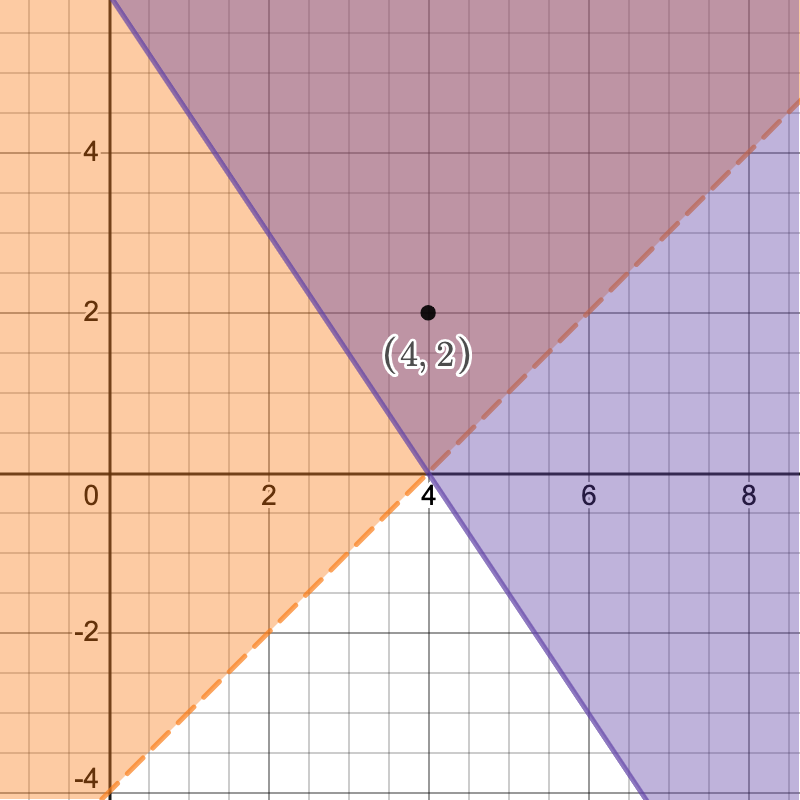
Determine the solution to the system:   \(3x+2y\ge12\) and \(y>x-4\).