In the last topic, writing an equation in slope intercept form requires the \(y\)-intercept \((0,b)).   There is another form that uses any point on the line to create an equation, it is called the point slope form.   Suppose the point \(P(x_p,y_p)\) is any point on the line with slope \(m\).   The point slope form is given by: $$y-y_p=m(x-x_p)$$
Write an equation in point slope form of a line that passes through the points \((-4,5)\) and \((2,-3)\).
| First find the slope: | \(m=\large{\frac{5--3}{-4-2}\normalsize{\implies m=}\frac{8}{-6}\normalsize{\implies m=-}\frac{4}{3}}\) |
| Choose a point to plug into point slope formula: | \((-4,5)\implies y-5=-\large{\frac{4}{3}}\normalsize{(x--4)}\) |
| \((2,-3)\implies y--3=-\large{\frac{4}{3}}\normalsize{(x+2)}\) | |
| Simplify if needed: | \(y-5=-\large{\frac{4}{3}}\normalsize{(x+4)}\) |
| \(y+3=-\large{\frac{4}{3}}\normalsize{(x+2)}\) |
NOTE:   The solution shown has both equations for both points.   Only one equation is needed to answer the problem.
The last form to consider is called the standard form.   It has a totally different look than the previous forms:
Typically, this equation is used in word problems.   For the fall play, the cost of an adult ticket is \($6\) and a student ticket costs \($3.50\).   If the Theater Department collects $412, then an equation that would be \(6a+3.5s=412\), where \(a\) is the number of adult tickets and \(s\) is the number of student tickets.   It is important to note, the standard equation does not have the slope written in it like the previous forms.   One important feature about standard form, the \(x\) and \(y\)-intercepts can easily be found.   The following example illustrates this technique.
Find the \(x\) and \(y\)-intercepts from the equation \(-4x+14y=84\).
Since the \(x\)-intercept is a point on the \(x\)-axis, the \(y\)-coordinate must be zero.   Therefore, substitute into the standard equation \(y=0\) and solve for \(x\): $$\begin{array}{l} -4x+14(0)=84 \\ \implies -4x=84 \\ \implies\frac{-4x}{4}=\frac{84}{-4} \\ \implies x=-21 \end{array}$$ So the \(x\)-intercept is the point \((-21,0)\;\color{green}{\checkmark}\)
Likewise, the \(y\)-intercept is a point on the \(y\)-axis, so the \(x\)-coordinate must be zero.   Using the same technique but substitute \(x=0\) and solve for \(y\): $$\begin{array}{l} -4(0)+14y=84 \\ \implies 14y=84 \\ \implies\frac{14y}{14}=\frac{84}{14} \\ \implies y=6 \end{array}$$ So the \(y\)-intercept is the point \((0,6)\;\color{green}{\checkmark}\)
One major use to finding the intercepts is that now a graph of the line can be created.   An example is shown in the video below.
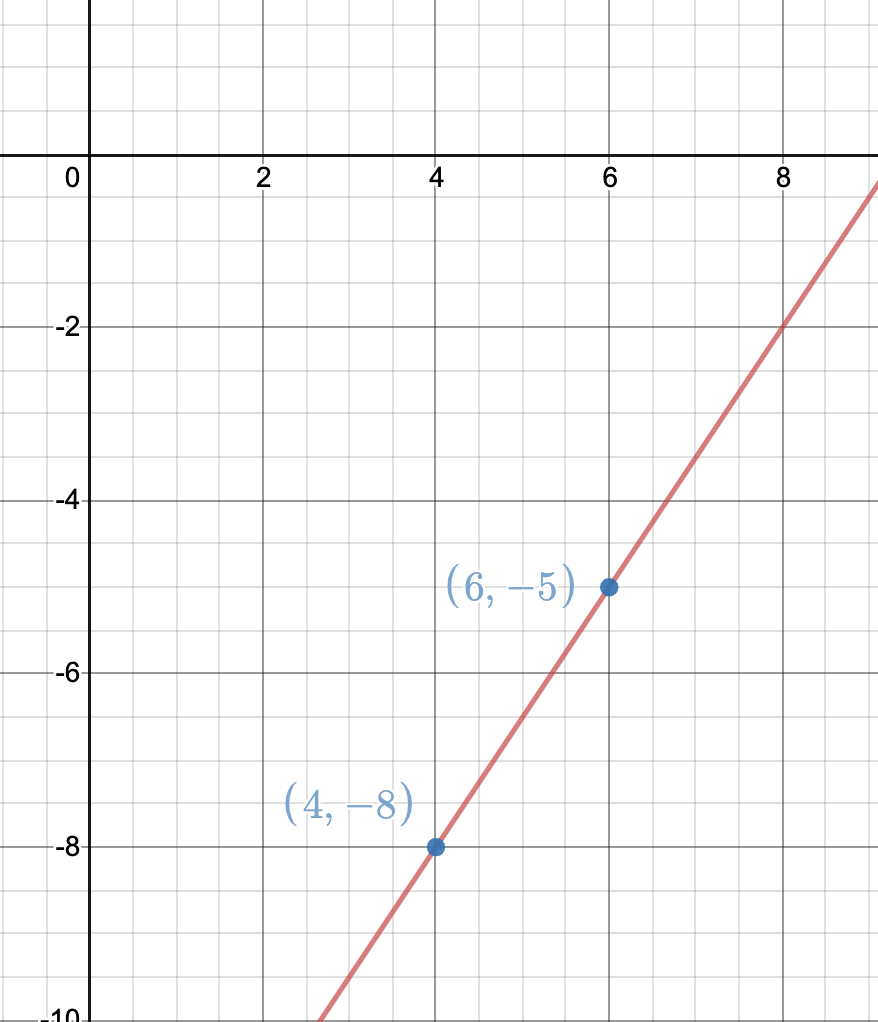
The process of graphing from point slope form is very similar to graphing from slope intercept form:   Graph \(y+8=\large{\frac{3}{2}}\normalsize{(x-4)}\).
| Determine the point given in the equation: | \(\implies(4,-8)\) |
| Use the slope to create another point: | \(\implies m=\large{\frac{3}{2}}\) means UP 3 and RIGHT 2 |
| Draw the line that passes through the two points. |
In the following video, I go through some examples on graphing and writing equations from the material in this lesson.