In the graph at the right, the horizontal axis shows the time, using units of minutes.   The vertical axis shows the distance ran, using units of miles.
What is the distance ran shown from the graph?   A total distance of 1.5 miles.
How long did it take to run that distance?   6 minutes
What is happening from 7 minutes to 8 minutes?   distance remains same, runner not moving
At what pace was the runner going?   1.5 miles in 6 minutes: \(\implies\frac{1.5}{6}=0.25\) miles per minute
What does \((4,1)\) mean in the context of the problem?   A distance of 1 mile was run in 4 minutes
These are the types of questions that involve key features.
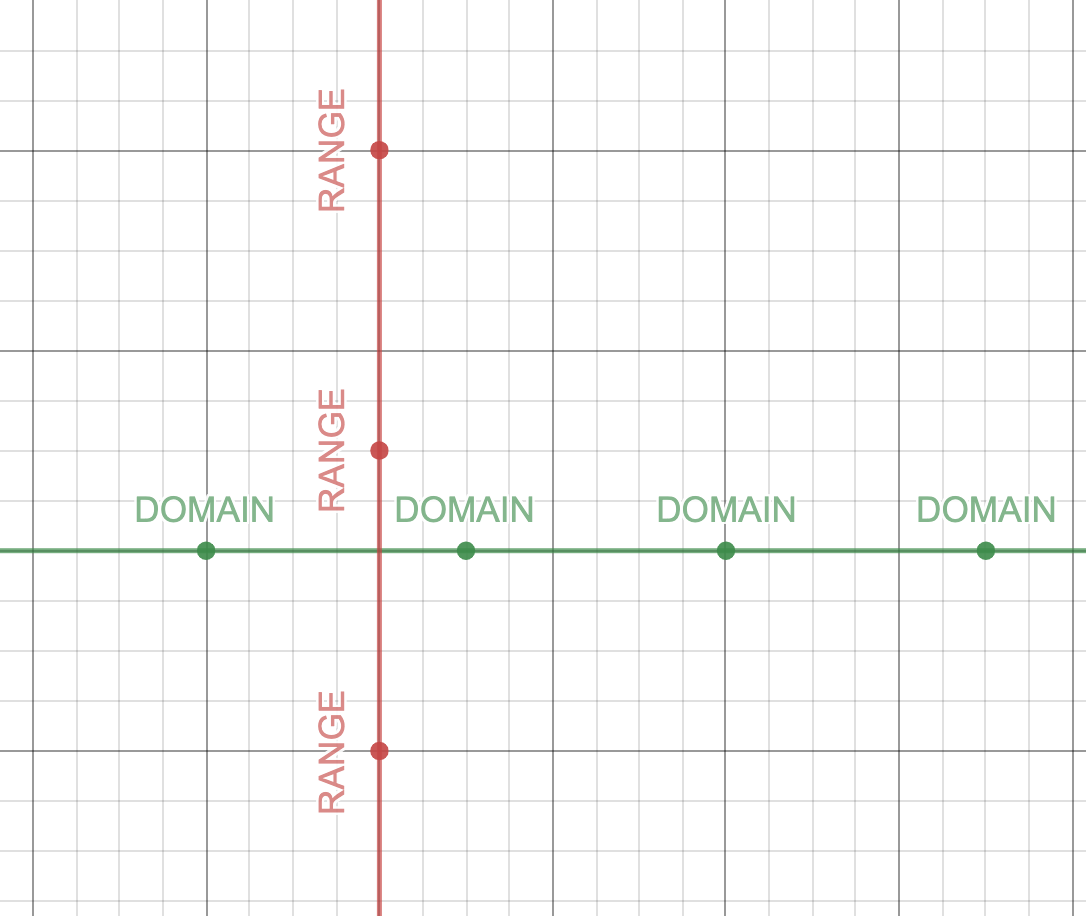
Typically, the horizontal axis is referred to as the "\(x\)"-axis and the vertical axis is referred to as the "\(y\)"-axis.   This helps when defining the domain and the range:
Domain:   describes all the \(x\)-values shown on the graph (HORIZONTAL)
It can be described in words:   "numbers greater than 5"
using inequalities:   \(x>5\)
OR in interval language:   \((5,\infty)\).
Range:   describes all the \(y\)-values shown on the graph (VERTICAL)
Described just like domain, but uses \(y\) intead of \(x\):
words:   "numbers less than or equal to -3"
inequalities:   \(y\le-3\) OR intervals:   \((-\infty,-3]\).
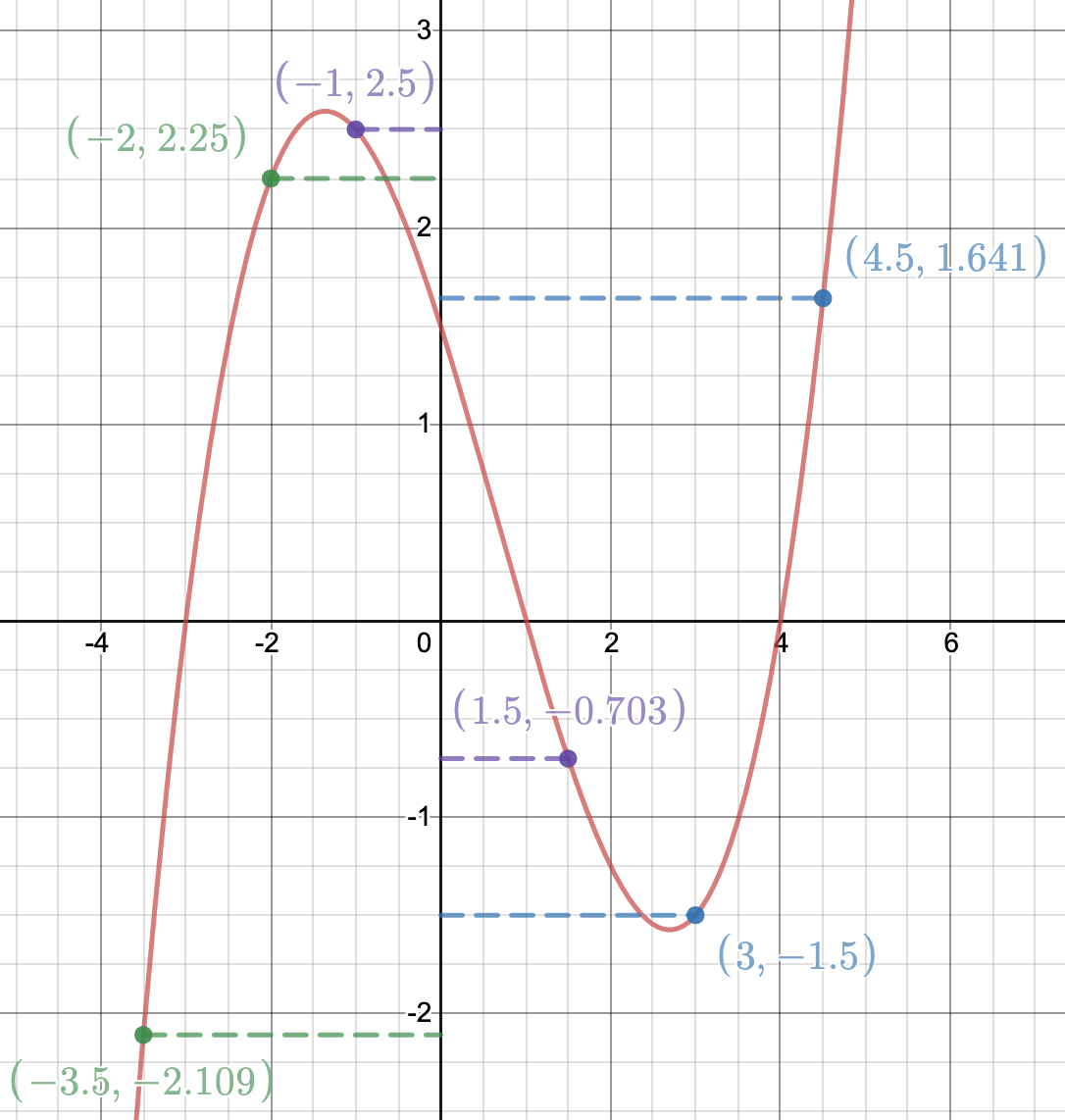
The \(x\)-values get larger moving from left to right across a graph.   What happens to the \(y\)-values?   Are the values getting smaller or larger?   This is the idea of increasing and decreasing.   The following graph shows the meaning of these two concepts:
In the graph at the right, there are two intervals where the graph is increasing and one interval where the graph is decreasing.
The green points on the graph show as the \(x\)-value grows from \(x=-3.5\) to \(x=-2\), the \(y\)-value is getting larger from \(y=-2.109\) to \(y=2.25\).   So the graph is increasing on this interval.
Looking in the "middle" part of the graph at the purple points, the \(x\)-values get larger from \(x=-1\) to \(x=1.5\).   However, the \(y\)-values are getting smaller from \(y=2.5\) to \(y=-0.703\).   This shows that the graph is decreasing on this interval.
In the last portion of the graph at the blue points, the \(x\)-values again get larger from \(x=3\) to \(x=4.5\), and the \(y\)-values are getting larger from \(y=-1.5\) to \(y=1.641\).   The graph is increasing again on this interval.
Graphs often have special points that are higher or lower than other points.   When a graph has a point that is larger than all the other points, it is called a maximum.   Likewise, if the point is smaller than all the other points, it is called a minimum.   This helps identify maximum and minimum points.   NOTE: the maximum or minimum value is just the \(y\)-coordinate only.
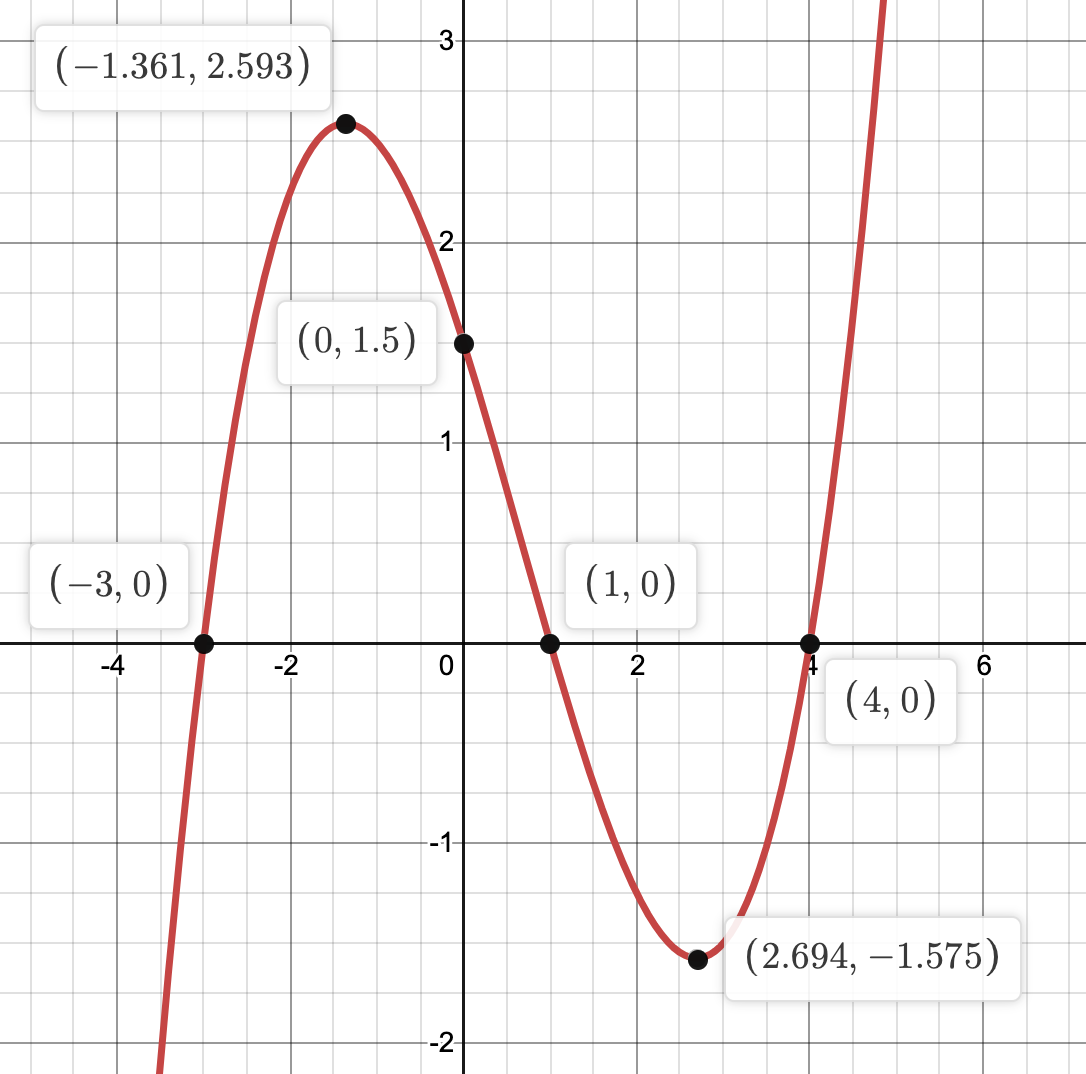
Other special points occur when the graph intersects with the horizontal or vertical axis.   These points are named in accordance with the intersecting axis.   The \(x\)-intercept is the point where the graph intersects the \(x\)-axis, and the \(y\)-coordinate equals 0.   The \(y\)-intercept is the point where the graph intersects the \(y\)-axis, and the \(x\)-coordinate equals 0.   The following example helps illustrate these ideas:
The graph hits the \(y\)-axis at \((0,1.5)\), so the \(y\)-intercept is the point \((0,1.5)\).
The graph hits the \(x\)-axis in three different points:   \((-3,0),\;(1,0)\) and \((4,0)\).   These three points are all \(x\)-intercepts.
A maximum point appears at \((-1.361,2.593)\).
A minimum point appears at \((2.694,-1.575)\).
NOTE:   Since this function has all real numbers as the domain, there are other points that have a larger value than the maximum and other points that have a smaller value than the minimum.   On the entire domain, this function does NOT have a maximum or a minimum.   This graph is meant to just show the concepts of a maximum and minimum point.