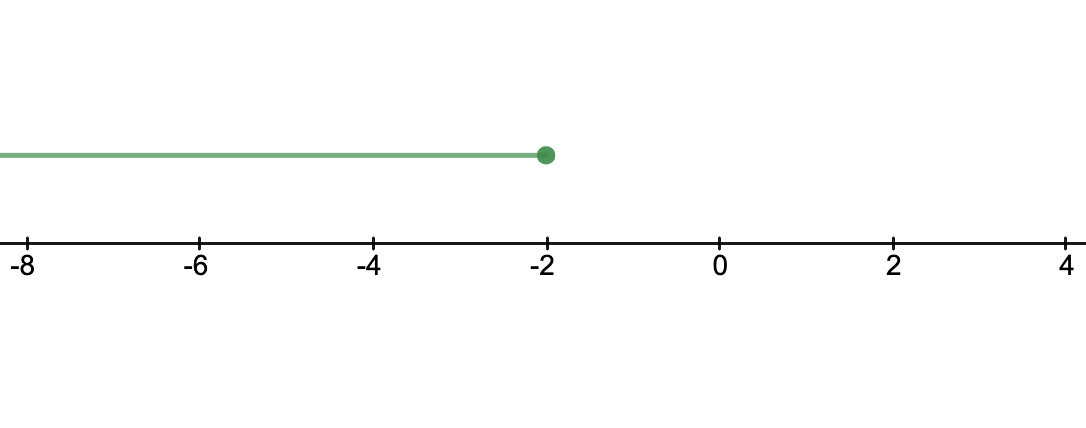
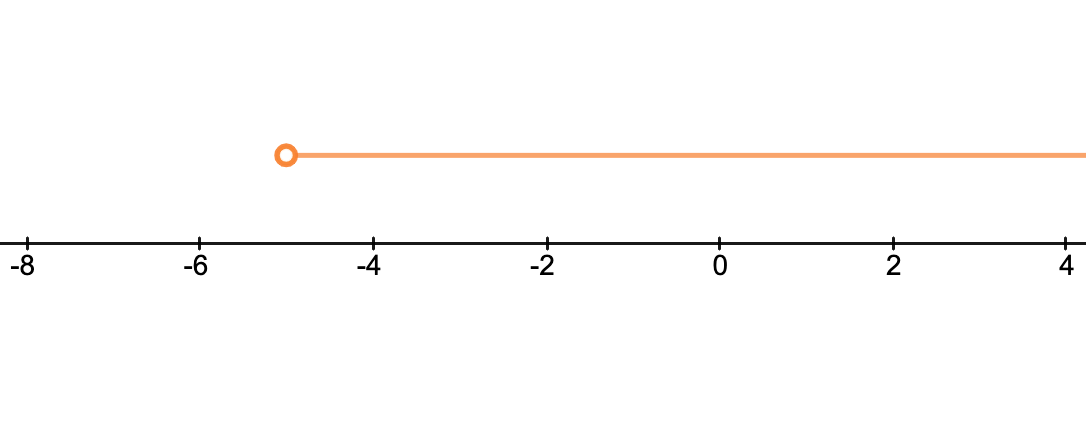
A linear inequalitiy is a comparision of two mathematical expressions using the symbols \(<,\;\le,\;>,\;\ge\).   While equations normally allow for one solution, inequalities allow for multiple solutions.   For example, having \(x\ge4\) allows for any number that is larger than \(4\), and also allows the number \(4\) as a solution.   Whereas \(x< -3\) allows numbers smaller than \(-3\), but does NOT allow \(-3\) as a solution.   Because of these restrictions, a graph on a number line helps show all possible solutions.
To graph solutions, there are two parts to consider.   First, the idea discussed above about the number being allowed or not allowed as a solution.   An open circle is used to signify when a number is not a solution, and a closed circle is used to signify when a number is a solution:
| Symbol | Meaning | Graphing |
|---|---|---|
| \(<\) | "less than" | Use open circle   \(\circ\) |
| \(>\) | "greater than" | Use open circle   \(\circ\) |
| \(\le\) | "less than or equal to" | Use closed circle   \(\bullet\) |
| \(\ge\) | "greater than or equal to" | Use closed circle   \(\bullet\) |
Second, on a number line indicate which numbers are solutions with an arrow.   For numbers smaller, the arrow will point to the left and for numbers larger, the arrow will point to the right.   The following table shows some examples:
| Inequality | Arrow Direction & Circle | Graphed Solution |
|---|---|---|
| \(x\le5\) | points left closed circle |
|
| \(x> -3\) | points right open circle |
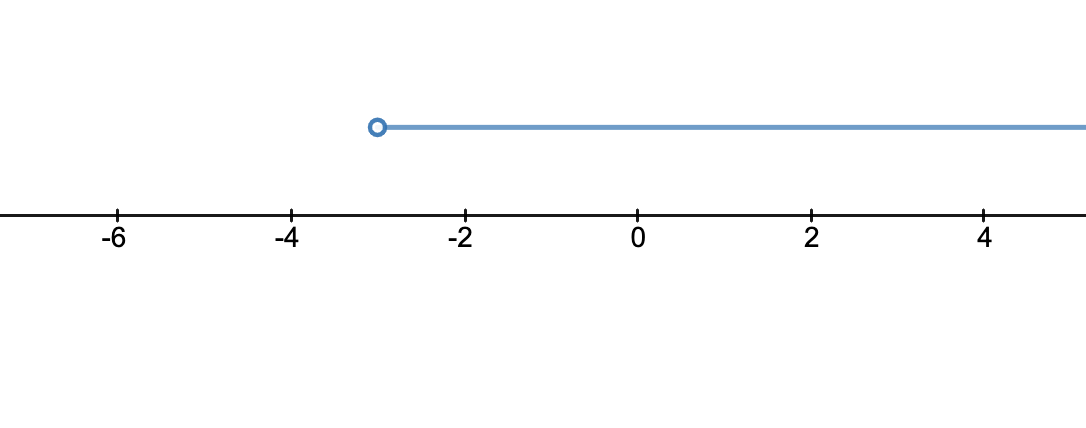
|
| \(-1< x\) | points right open circle |
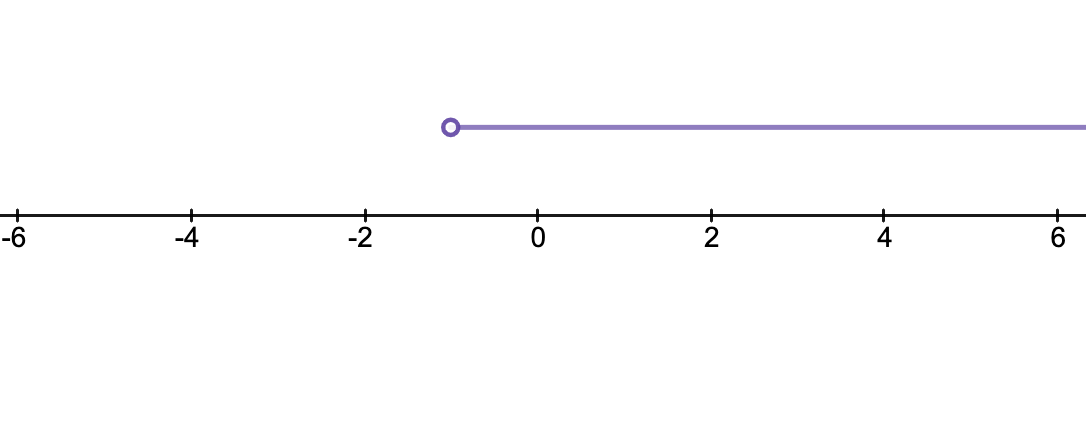
  The last example in the table above shows a less than problem, but the arrow graphs to the right??   This is due to the fact that the variable \(x\) is listed on the right side of the inequalitiy instead of on the left.   A very common error is to assume less than problems always have arrows left and greater than problems always have arrows right.   This is only true if the variable is on the left side of the inequality.   To help avoid this confusion, always read the inequality from left to right.   In the example in the table, \(-1< x\) would read as "\(-1\) is less than any number \(x\)", making \(-1\) the smallest number allowed, so all number larger are the solution.
In order to solve inequalities, a few key topics need to be addressed:
This says that adding or subtracting on BOTH sides on an inequality keeps the symbol the same.   Also, multiplying or dividing by a positive number keeps the symbol the same.   These statements allow solving to proceed just like the problem was an equation with one key point to remember:
However, the last point indicates that multiplying or dividing on BOTH sides of the inequality changes the symbol direction.   The following examples show these concepts.
| Subtract \(9\): | \(9\color{red}{-9}+4t>21\color{red}{-9}\) |
| Simplify: | \(4t>12\) |
| Divide by \(4\): | \(\large{\frac{4t}{\color{red}{4}}}\normalsize{>}\large{\frac{12}{\color{red}{4}}}\) |
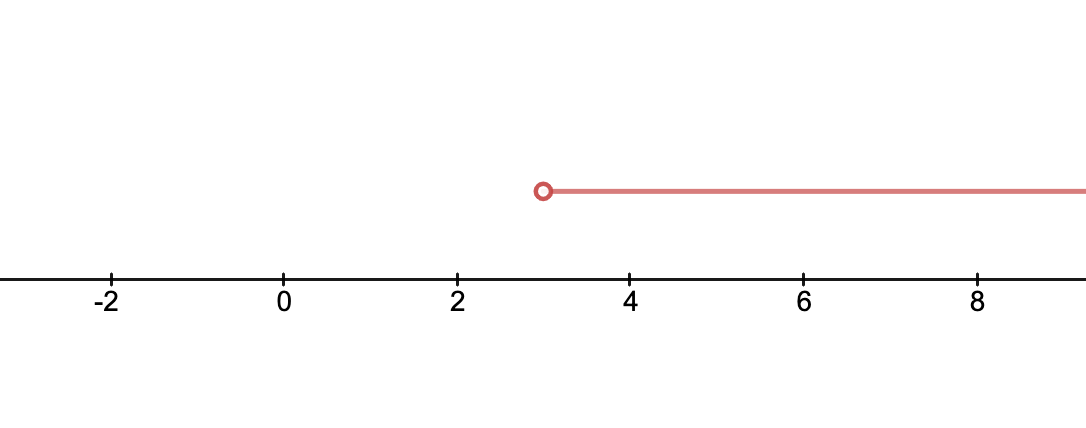
| Simplify: | \(t>3\) |
| Distribute \(5\): | \(4+2w\ge\color{red}{5}w+\color{red}{5}\cdot2\) |
| Simplify: | \(4+2w\ge5w+10\) |
| Subtract \(5w\): | \(4+2w\color{red}{-5w}\ge5w+10\color{red}{-5w}\) |
| Simplify: | \(4-3w\ge10\) |
| Subtract \(4\): | \(4\color{red}{-4}-3w\ge10\color{red}{-4}\) |
| Simplify: | \(-3w\ge6\) |
| Divide by \(-3\): | \(\large{\frac{-3w}{\color{red}{-3}}}\normalsize{\ge}\large{\frac{6}{-3}}\) |
| SWITCH SYMBOL!! | \(w\le-2\) |
| Add \(z\): | \(16-40z\color{red}{+z}< 211-z\color{red}{+z}\) |
| Simplify: | \(16-39z< 211\) |
| Subtract \(16\): | \(16\color{red}{-16}-39z< 211\color{red}{-16}\) |
| Simplify: | \(-39z< 195\) |
| Divide by \(-39\): | \(\large{\frac{-39z}{\color{red}{-39}}}\normalsize{<}\large{\frac{195}{\color{red}{-39}}}\) |
| SWITCH SYMBOL!! | \(z>-5\) |
Pay attention to the last two examples.   These show the KEY POINT mentioned above that whenever multiplication or division to BOTH sides has a negative number, then the inequality symbol must change direction.