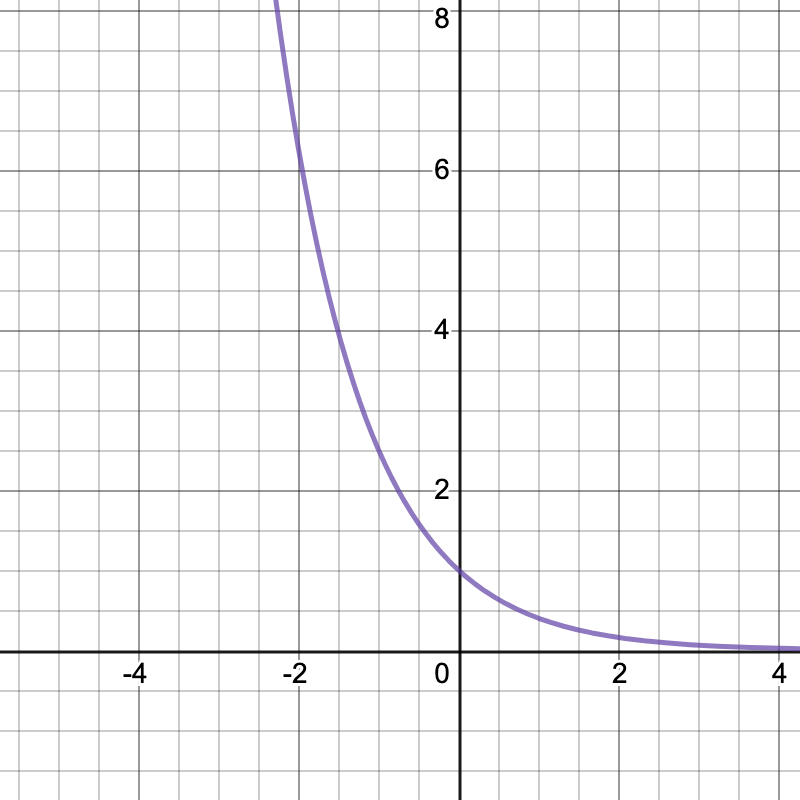
Introduction:
The general exponential function is a function written in the form \(f(x)=a(b)^x\), where the base \(b>0\) and \(b\ne1\). It is called an exponential function because the variable \(x\) is in the exponent position. The value of \(a\) is the \(y\)-coordinate of the \(y\)-intercept: when \(x=0\), \(y=a(b)^0\implies y=a(1)\implies y=a\). There are two types of graphs for an exponential function:
Exponential Growth
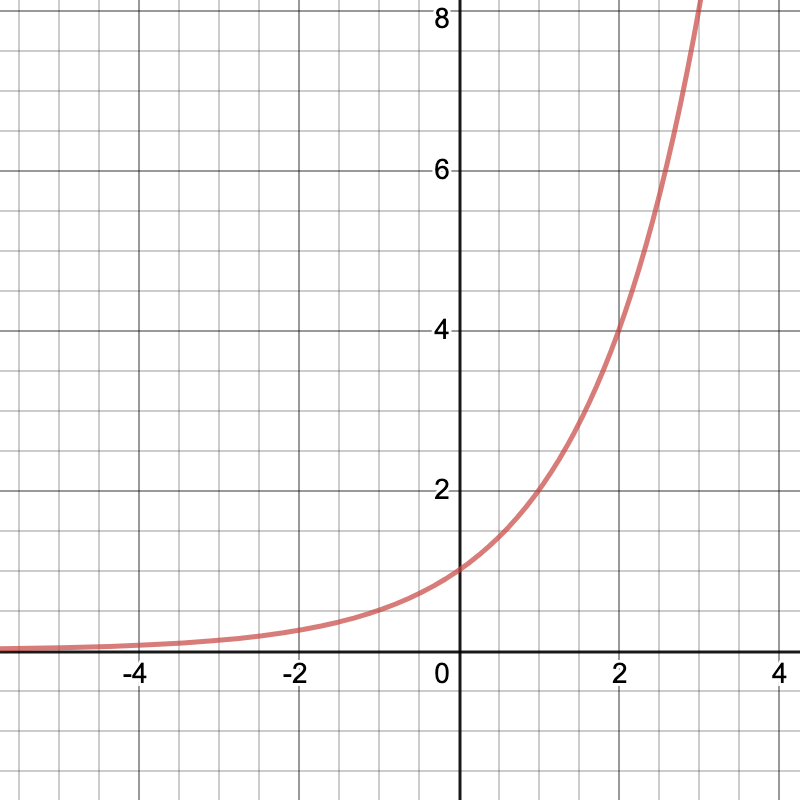
When \(b>1\), exponential growth occurs. The graph below shows a growth curve.
- Domain: \((-\infty,\infty)\) and Range: \((0,\infty)\)
- \(y\)-intercept: \((0,a)\); always INCREASING
Exponential Decay
When \(0< b< 1\), exponential decay occurs. The graph below shows a decay curve.
- Domain: \((-\infty,\infty)\) and Range: \((0,\infty)\)
- \(y\)-intercept: \((0,a)\); always DECREASING